The New Growth Project is a charity project that we have started with The Garden School to provide free horticultural training to unemployed people. The first course shall take place in our garden in Co. Mayo. There are no course fees and the course does not receive any goverment funding. We are going to grow this project to provide training to more people and offer more courses.
Any profits made from The Garden School will go to The New Growth Project. If you want to support our project you can do so by enrolling on a course, book a one day course in our garden, we can come to your garden to deliver a course, you can buy a T-Shirt
Anyone over the age of 18 and not currently in employment, not taking part in a training programme or in education is entitled to apply. No experience in horticulture is required and no knowledge of gardening is expected.
Successful applicants must show an interest in gardening/nature and be willing to work in an outdoor environment including enduring a little rain. Participants will need to have their own transport.
Course Contents
Through the practical work, instruction and homework participants on the course will learn a number of skills and gain horticultural knowledge over a number of subjects. There will be an opportunity to prepare for and sit one unit of Royal Horticultural Society examinations. Participants will gain a basic understanding of the following:
•Propagate and grow new plants from seeds and cuttings
•Name a range of plants
•Understand how plants grow and their requirements for healthy growth
•Grow vegetables and fruit for home use.
•Select, places and plant ornamental plants in borders and in the garden
•Weed control
•Pruning
•Garden layout
•Environmental impacts of horticulture and sustainability issues
•Use of tools
•Organic methods of treating plant problems
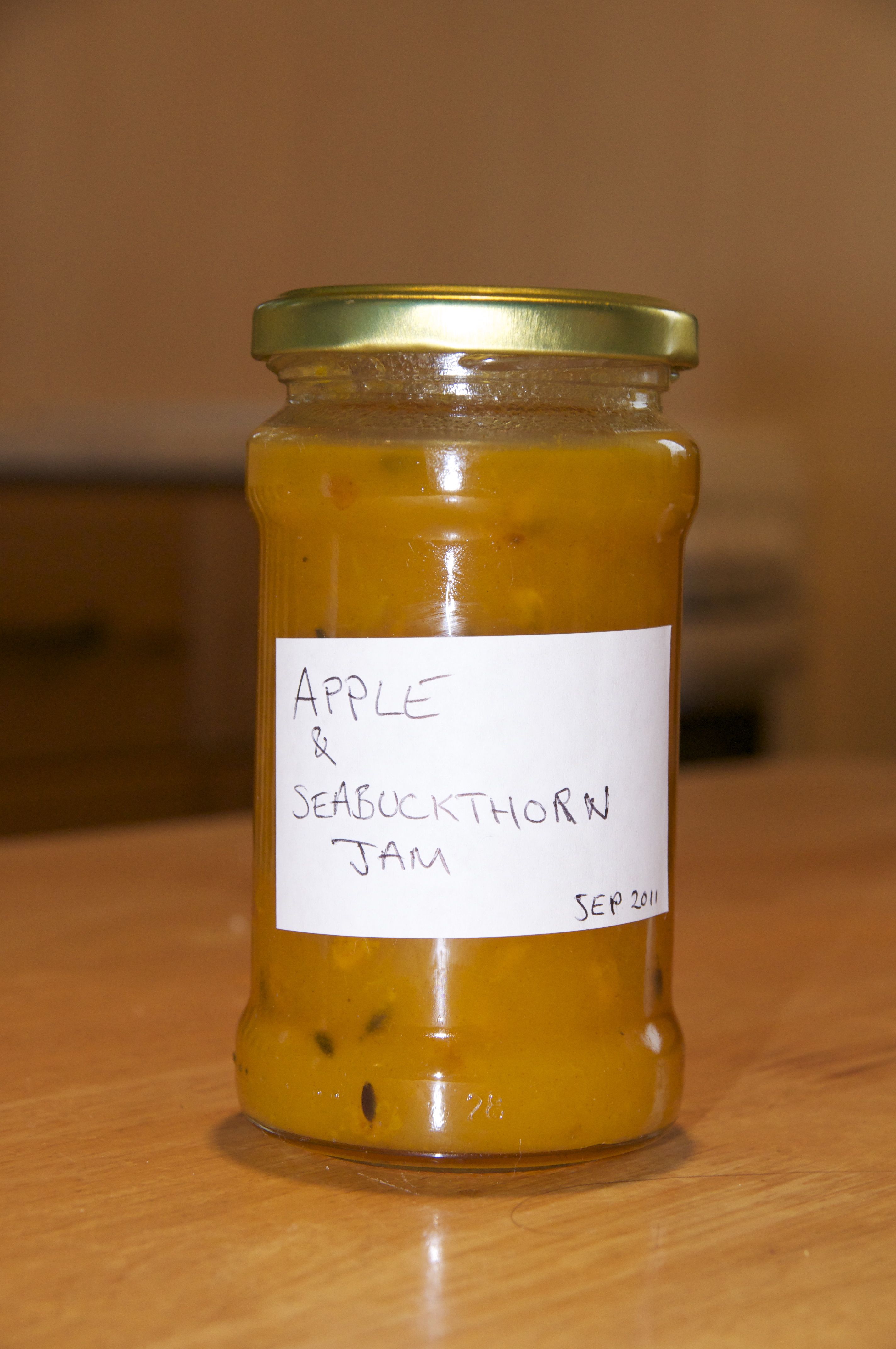
I was getting ready to do a talk to the North Mayo Garden Club today, and as I was going through my presentation I remembered that I had a few pots of delicious apple and sea buckthorn jam left. Sea buckthorn berries are a super health food; one small berry can have a Vitamin C content equal to that of six oranges, packed with atioxidants and a number of omega oils, it is a wonder fruit. It is also a wondeful tasting berry. Eaten straight from the bush it may be a bit sharp for many peoples’ tastes, but blended with juices or as an ingredient in cooking it is delicious, unique and colourful.
Sea Buckthorn berries - Hippophae rhamnoides
The first of our bushes that we planted gave us a good crop this year, or to be more specific the female plant cropped well. We originally planted two varieties, Rudolph, a male to pollinate, and Raisa a female to fruit, both purchased in Finland while on holidays three years ago. Last year we had a few berries but this year we have lots in the freezer and enough to make jam. We have since planted five more female varieties, we are sure Rudolph will be up to the job, and are looking forward to great crops in the coming years.
To make the flavour of this year’s berries go further, I mixed the berries with apple to make jam. It turned out great, it is one of my favourite jams, sea buckthorns are one of my favourite berries. Below is the recipe that I used for the jam. I am going to take a jar with me to my talk tonight so that people can have a taste of sea buckthorn, for most it will probably be their first time. Perhaps some gardeners might be inspired to grow these great plants.
Apple and Sea Buckthorn Jam
Jar of home made Apple and Sea buckthorn Jam
900ml of sea buckthorn berries
3 litres of peeled and chopped desert apples
1 Kg of sugar
300 ml of water
1. Cook the berries, water and apples over a low heat for about fifteen minutes or until the apple is soft.
2. Slowly add the sugar, stirring well to ensure the fruit dissolves.
3. Turn heat up and cook the jam for about fifteen or twenty minutes.
4. Spoon the jam into sterilized glass jars and tighten lids immediately. (Wash used jam jars with soapy water, then dry off and place in cold oven an heat to 100 degrees celcius).
North Mayo Garden Club, talk tonight Tuesday 8th of November- Top Fruit, Soft Fruit and Strange Fruit- a talk by Ciaran Burke. Venue Merry Monk, Killala Road, Ballina, Co. Mayo, Ireland. 8 pm.
Talk will also be given to Claregalway GIY on Wednesday 23rd November at Arches Hotel, Claregalway, Co. Galway at 8 pm.
BLUE BERRY, BILBERRY,FROACHAN, VACCINIUM MYRTILLLUS- FRUIT
I have been in Finland for the last couple of weeks with my wife Hanna, a native of this beautiful tree filled land. Finland is the most forested country in the EU. Approximately 74% of the country is covered in forest. One gets the impression that even the biggest towns and cities are living areas carved from the forests, trees are never far away. The green gold of Finland provides an important source of income, but the forests are more than resources to be harvested and sold.
Driving through the country, large pines and birches tower either side of the road. The roads are like veins and arteries carrying civilization, through a forested body; it is in this arboreal body in which the Finnish soul resides.
In European folklores, the woods are scary places; big bad wolves attack innocent girls on their way to visit their grand mothers. In Finland however the forests are considered a place of beauty, where most people spend their summer holidays, surrounded by the beauty. In summer as you drive along one of the arterial routes of civilization, you are sure to see people walking to the forests with empty buckets in search for berries or coming from the woods with baskets of mushrooms. Gathering food from the forest floor is a national pass time, or in some cases an obsession.
The two most numerous berry types are lingon berry and wild blueberry, bilberry, or froachan as we call it in Ireland. Both are species of Vaccinium, the former, V. vitis-idea and the latter V. myrtillus. Finns may love their forests, but they are intensely proud of their berries too. Ask them and most will tell you that the Finnish blueberries are the best. Families often have their own preferred places for picking; this information is not shared with others.
Last week we were in Hanko, the southern most tip of Finland. Here the forest is chiefly composed of tall pines. We got a report that the blue berries were plentiful, we went for a walk to see. As often happens in this wooded land, a short stroll became a berry picking expedition. The hot and high afternoon sun filtered through the open pines to dapple light patterns on the sandy forest floor. Mosses and lichens made a soft bed for heathers and blueberries to grow in the shade. We picked a litre of berries and returned home.
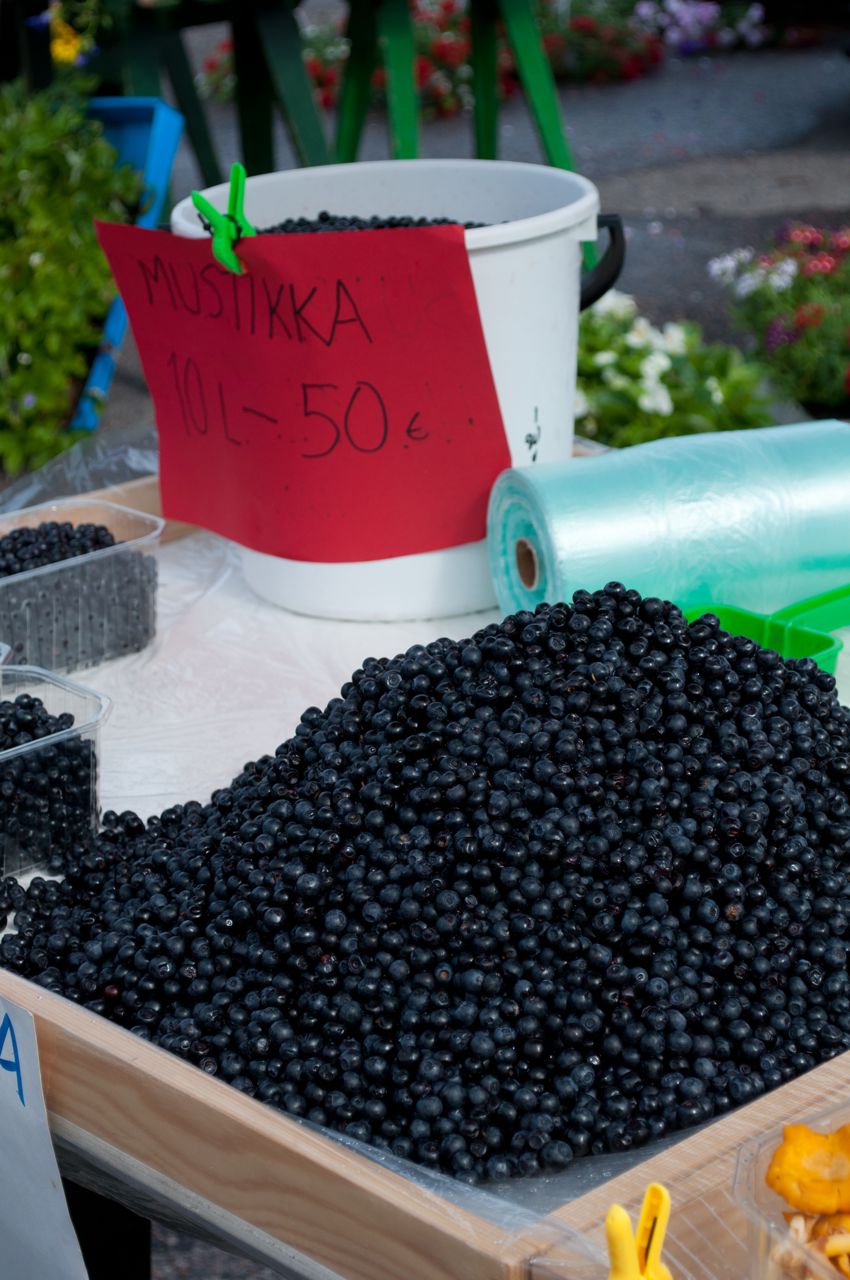
WILD BLUE BERRIES PILED ON THE MARKET STALL
Early the next morning we visited the market in Hanko. Here in a car park in the town, adjacent to a filling station, wild blue berries were piled high on a table. The berry sellers were Asian women, Burmese refugees. They pick them in the woods and sell the in the market, their produce marked clearly that they are Suomi, Finnish. Farmers sold vegetables, there were stalls for locally caught fish too. The vegetables stalls sold potatoes measured in kappa’s. A kappa is a wooden box, a 5 litre box is a full kappa, a 2 litre is half. These are traditional measurements used for selling potatoes, converted to metric measurements, the boxes complete with official stamps. Most fruits and vegetables are sold by volume and not by weight at the Finnish markets. French beans, green and yellow are measured in litre and half litre measuring cups.
FRANCH BEANS ON THE MARKET STALL
We purchased an additional litre of blue berries and potatoes and vegetables for dinner; then we cycled home to make some jam.
BLUE BERRY JAM INGREDIENTS
In a saucepan I cooked the berries with a small amount of water until the fruit had become soft, a wonderful fruity fragrance filled the kitchen. After about ten minutes of slowly cooking the fruit I gradually added 500g of sugar, made from Finnish grown sugar beet, unlike Ireland they saved their sugar beet industry from EU eradication. When all the sugar was added and dissolved, I turned up the heat and the jam boiled hard. I continued cooking the jam, stirring occasionally until the jam was not running off the wooden spoon.
ADDING SUGAR TO THE JAM
The messiest part of jam making is always when I fill the jars. The jars were heated in the oven so as to sterilize them; they were first washed, then dried and placed in a cold oven. I heat the oven to 100 degrees Celsius and the jars remain in the oven until I am ready to fill them.
POTS OF BLUE BERRY JAM
Later when the filled jars had cooled and the jam was set, we ate Finnish oven pancake over which we spooned this delicious wild blue berry jam. We ate it with home made buns, on bread, and spooned straight from the jar. There is nothing quite like home made jam, wild blue berry jam made with berries from the woodland, delicious!
Next week I will be visiting Finland. Each year my wife and I visit her homeland and her family and friends. I like Finland, in the summer the nights are long, the weather better than Ireland and in the winter the deep snow and cold crisp weather is refreshing. The Finns are nice people, polite and pleasant, direct and honest.
When you visit foreign places, you look for similarities, you also notice differences. The people you meet treat you as an exotic, they too look for similarities between our cultures and also observe the differences. Sometimes both can create amusing situations. A simple act on my part, a common place action in my home land can create amusement and people might make remarks. A straight forward act such as putting jam on your bread in the morning, a good example. Finns eat bread for their breakfast, they also eat jam, but the two do not meet. No, black currant jam does not get spread on their leipä, instead they eat their black currant hillo with meat. A popular home made dish is Kanaviilokki, a chicken curry and it is always served with jam, black currant jam. Imagine sitting down at the local Indian curry house, the waiter has served you your tandori chicken and asks you if there is anything else he can get you, to which you reply, “may I have a side order of black currant jam to go with this please?”. I am tempted to try it. Well until I get that opportunity I decided to give it ago at home. Hanna supplied the recipe, just like Finnish mums have been making it for decades, but with a few slight variations.
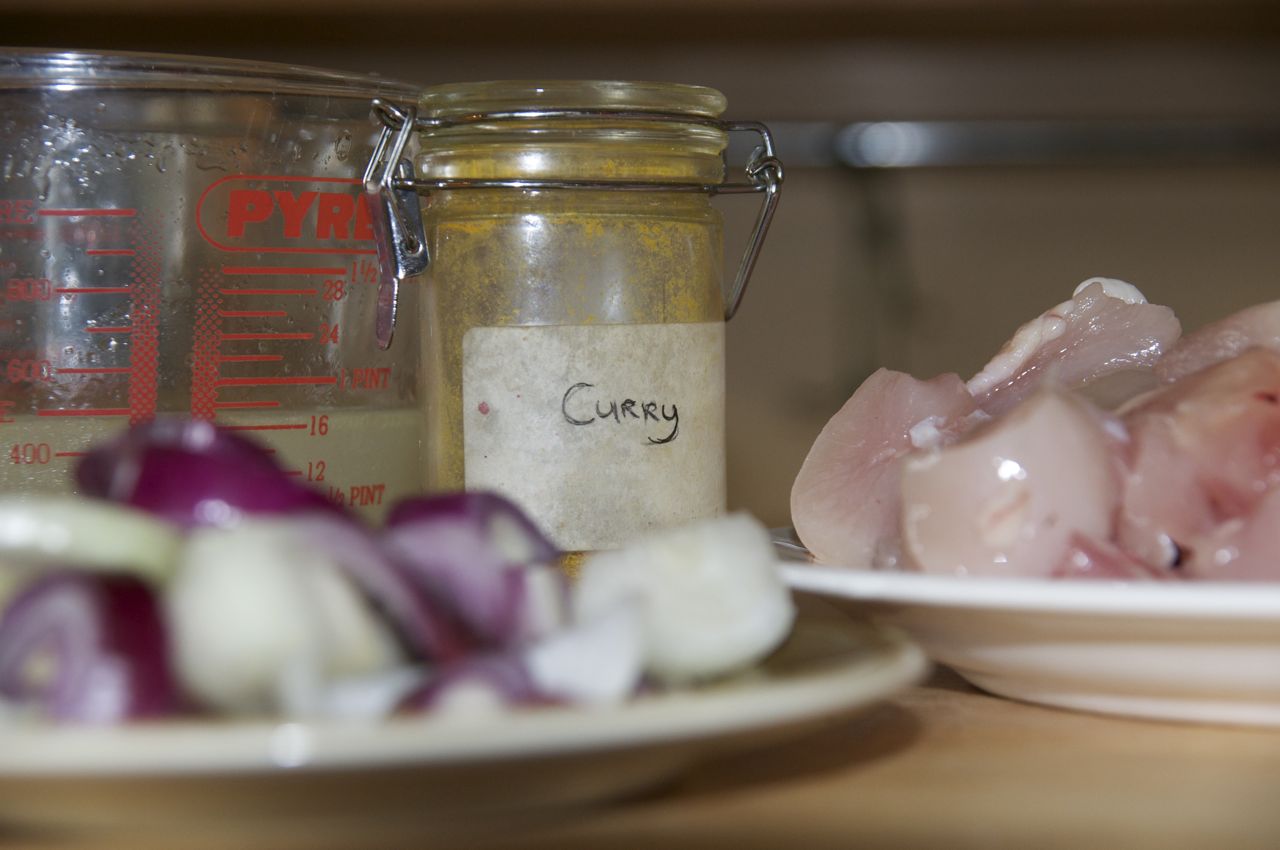
You can’t get whole chikens in the shop in Finland, you can only get portions or what they call broiler meat. We used a large breast and two thighs which we had cut up into portions when we bought our organic chiken from Irish Organic meats at Boyle farmers market, Hanna ground up the curry spices fresh, and the chicken stock came from our freezer, made from the carcass of an organic chicken after portioning it up. We use brown basmati rice.
INGREDIENTS FOR KANAVIILOKKI
KANAVIILOKKI
INGREDIENTS:
500g of chicken, cut into pieces
1 large onion, chopped coarsely
500ml chicken stock
3 teaspoons of curry powder (depending on which mix you use, add less at first and add more as it cooks if you think it needs it)
Butter for frying
cornflower for thikening
Black Currant Jam for serving
Brown Basmati Rice
METHOD
Melt a large knob of butter in a large sauce pan. I add a little rape seed oil to help stop the butter burning. Use a medium to low heat.
Add the onion and saute until it starts to soften.
Add curry powder and continue to cook until the onion softens and turns golden. Be careful not to let the onion burn and don’t let it stick to the pan, keep it moving around.
Chicken can now be added, turn up the heat a little and stir around until the meat is sealed.
Pour in the chicken stock, turn up the heat until the liquid boils and then lower the heat and cover the pot.
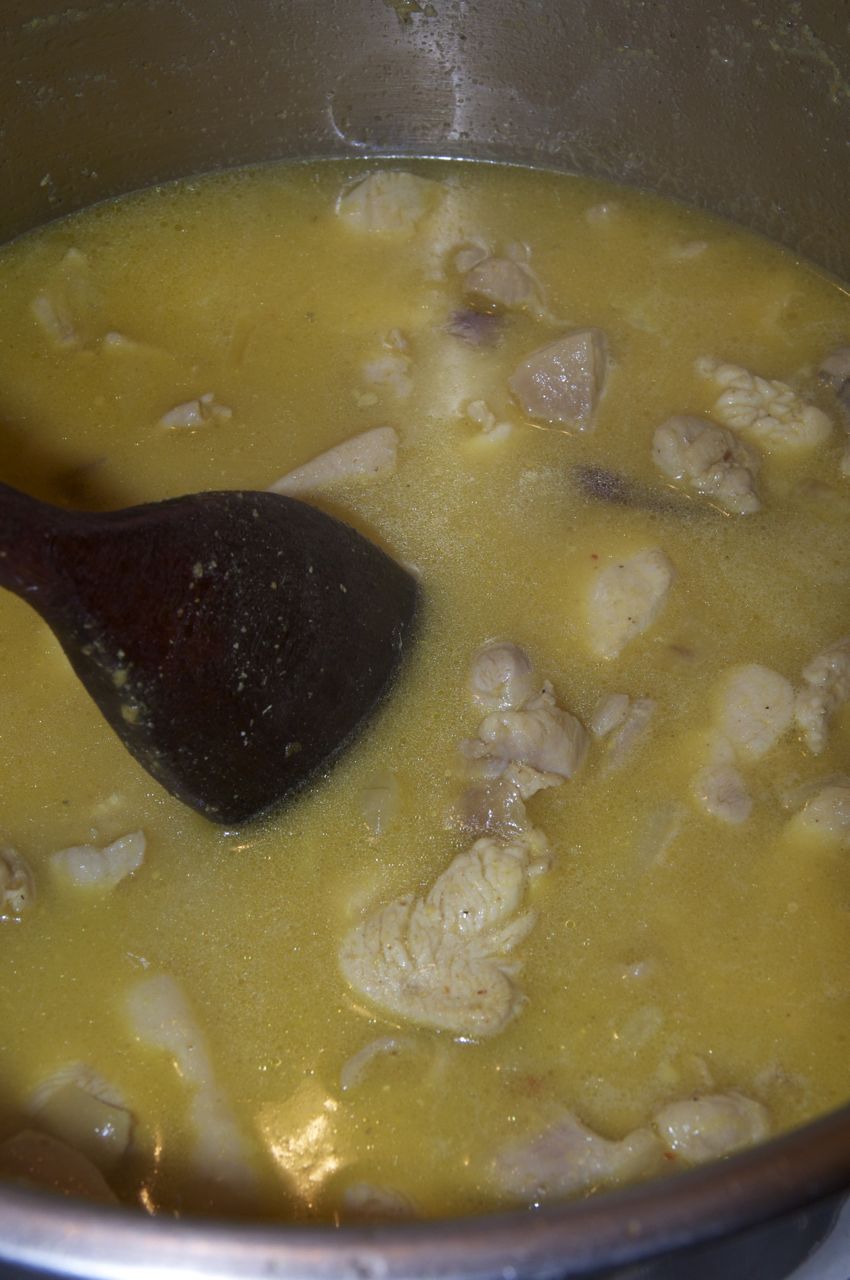
Let the mixture simmer for 40 minutes, stirring every now and again to prevent it sticking
Put a couple of tea spoons of corn flower in a cup and add a little water, stir to make a paste.
Add a little of the cornflower at a time and stir until the curry starts to thicken, cook for another few minutes, stirring frequently.
Serve the curry with boiled rice and a side dish of black currant jam.
KANAVIILOKKI - CHICKEN CURRYKANAVIILOKKI
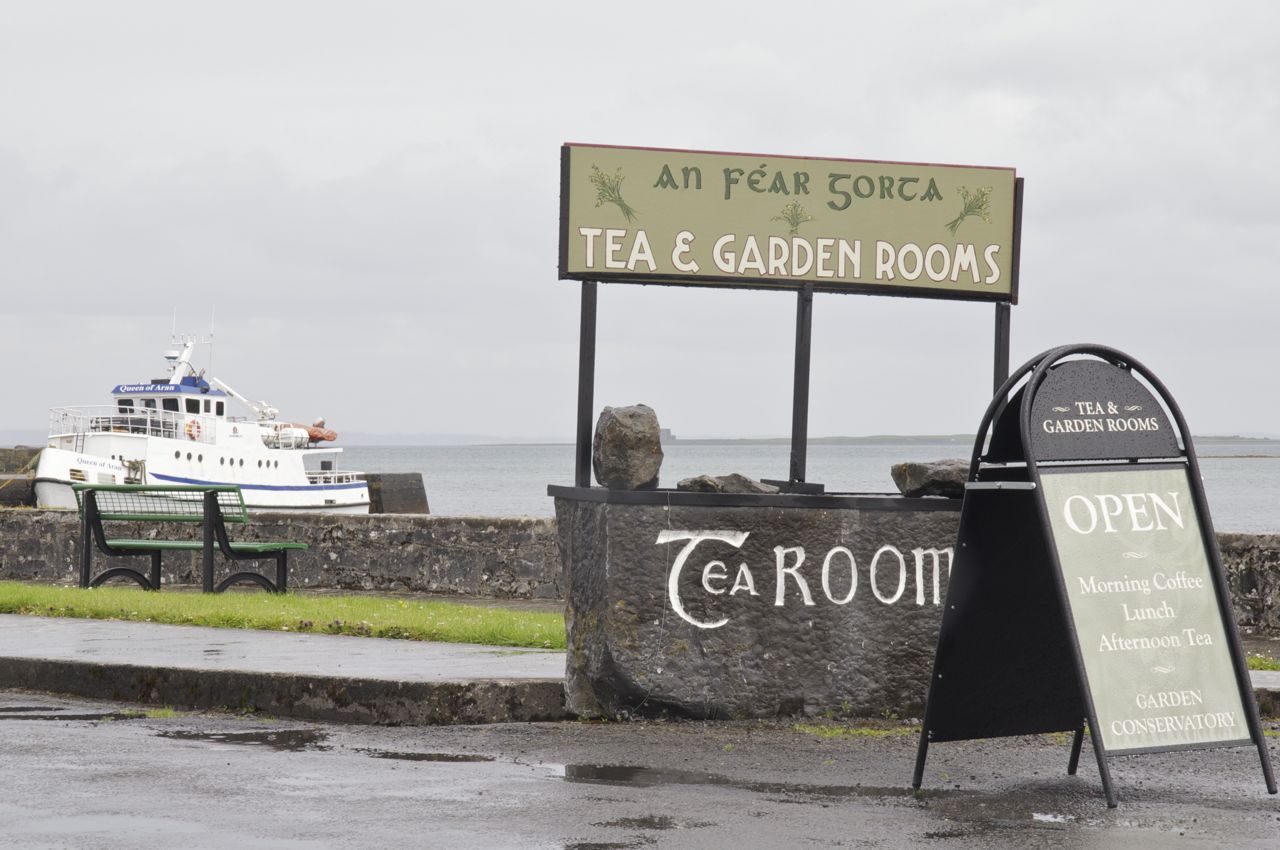
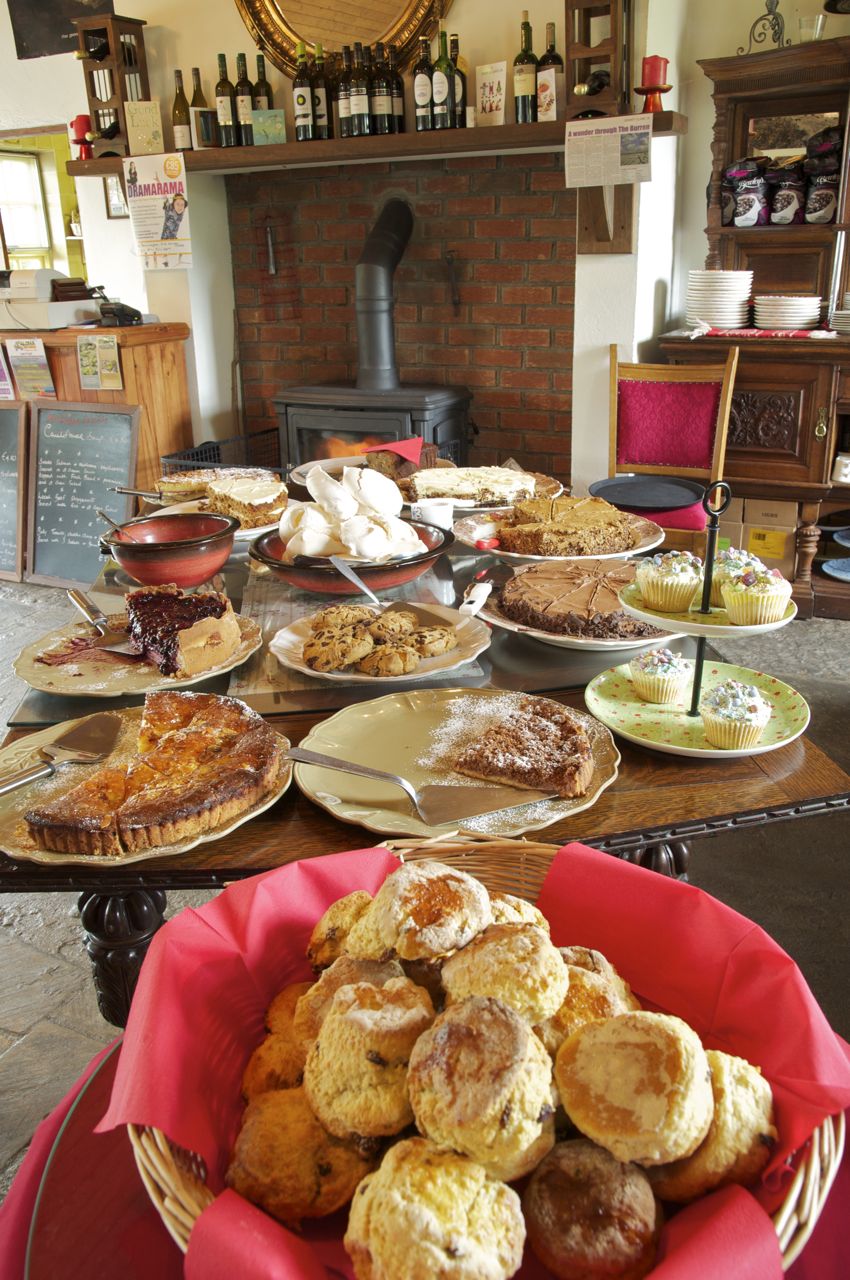
It is not unusual for a public garden to have a good coffee shop or restaurant, less usual is for a restaurant to have a good public garden. An Fear Gorta (The Hungry Man) Tea and Garden Rooms in the Atlantic coast town of Ballyvaughan in Co. Clare is one such exception. Located right on the harbour, the picturesque building not only offers a great selection of cakes but it has a delightful cottage style garden in which to enjoy your food when the weather is good, or just to admire from the warm room or conservatory on a wet day.
AN FEAR GORTA - TEA ROOMS ENTRANCE
Katherine O’Donoghue started the business in 1981, the property had had a complete refurbishment. It was once a Coast Guard’s building and dates back to the 1790’s. Today it is a cosy and welcoming tea rooms which are run by her daughter Jane. Katherine has retired and last year she started a course in garden design, I was her tutor on the RHS course which I held for The Garden School. On the last day of the course she reminded me that I must drop in to see her garden and visit the Tea Rooms if ever I was in the area. The area, Ballyvaughan, is in County Clare and is situated in the Burren, an area of scientific interest and well known to geologists, botanists, gardeners and lovers of nature. The Burren features large areas of limestone pavements and is home to plant species otherwise found in Arctic and Eruropean Alpine habitats. Side by side Dryas octopetela and Geranium sanguineum grow and flower in early summer, accompanied by orchids and other interesting flora.
LIMESTONE PAVEMENT, BURREN, CO. CLARE
My trip to the Burren with my wife Hanna, was not to admire the wild flowers but to visit a private garden, Caher Bridge Garden in Fanore. Ballyvaughan is about two hours drive from our home in Co. Mayo, the perfect distance for a coffee or tea break. We left our garden in lovely sunshine only to see the cloud increasing as we travelled south. As we passed galway the rain started to bucket down and when we arrived at the tea rooms it was lashing rain. We ran quickly inside and we were welcomed by the smiling staff and Katherine’s daughter Jane. There was also a roaring fire in the stove, such are Irish summers, fires are often needed. We ordered our drinks and our eyes hungrily tasted each of the cakes as a young lady explained about each one, we both went for the damson and almond cake.
RANGE OF CAKESAN FEAR GORTA TEA ROOMS -INTERIOR
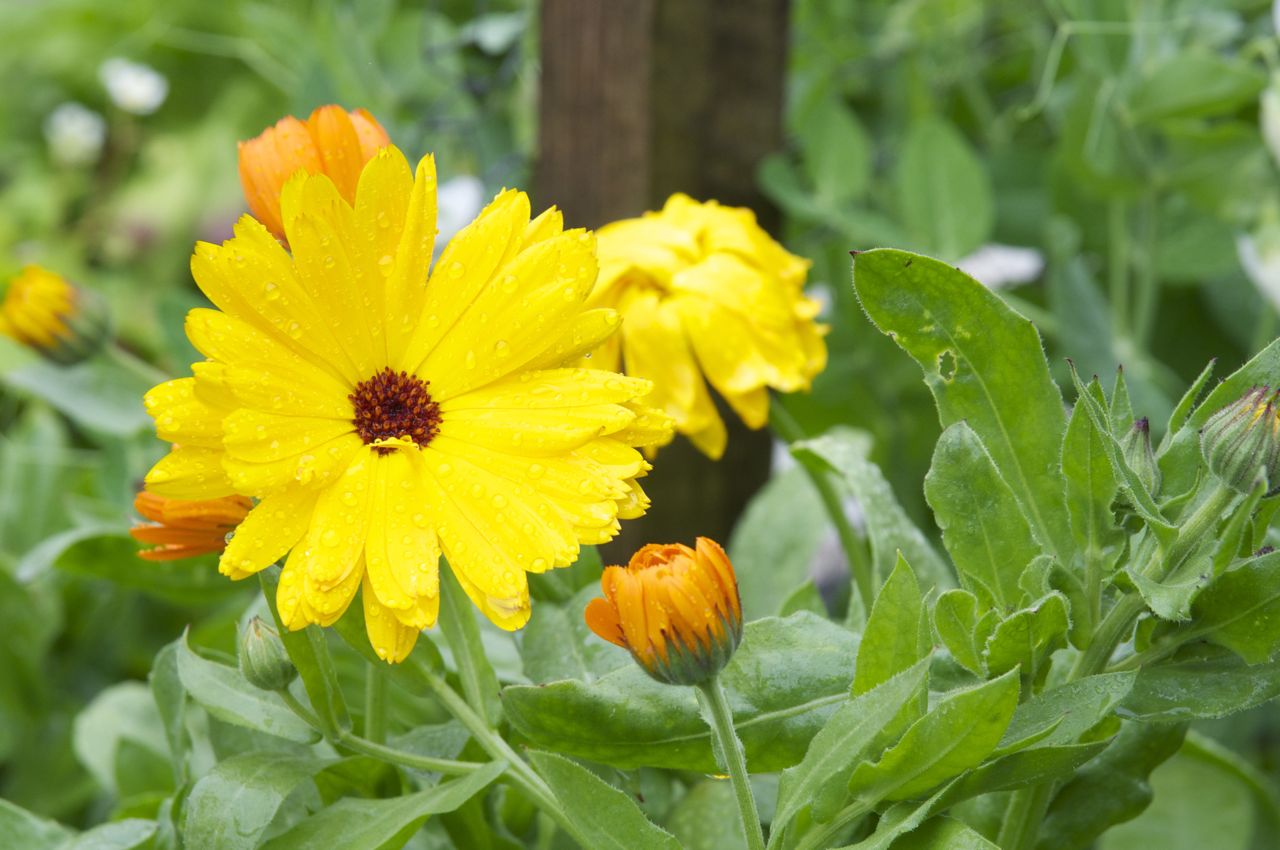
We sat on the comfortable sofa and admired the tastefully decorated premises, full of character and charm. We finished our cake and looked out at the garden from the conservatory, the rain had eased a little. Katherine was not there but she had left instructions with jane to show us where to go and we went for a walk in the rain and admired her gardening work. A large vegetable patch with bright orange calendula flowers that beamed with warmth even beneath the grey wet skies was evidence that Katherine has been far from idle in her retirement. White daisies of feverfew mingled with the vegetables growing in raised beds made from local stone. Clematis flowers dripped in the rain as we admired the garden, charmed by the atmosphere.
CALENDULA OFFICINALIS FLOWER
The rain started heavy again, we returned to the dry refuge of the conservatory, from here we could admire the view of the garden and dream of a dry day in which we could sip a drink, nibble a cake and soak in the prettiness of the cottage garden instead of the rain.Above our heads a pink passion flower bloomed, pots of plants along by the windows were further evidence of katherine’s gardening obsession. In these days of mulit-store franchises it is refreshing to find an establishment with personality, individuality, warmth and charm. Not to mention a pretty garden, delicious cakes and friendly people. We will return, rain or shine.
VIEW FROM CONSERVATORY OF BACK GARDEN SEATING AREA
The rain started heavy again, we returned to the dry refuge of the conservatory, from here we could admire the view of the garden and dream of a dry day in which we could sip a drink, nibble a cake and soak in the prettiness of the cottage garden instead of the rain.Above our heads a pink passion flower bloomed, pots of plants along by the windows were further evidence of katherine’s gardening obsession. In these days of mulit-store franchises it is refreshing to find an establishment with personality, individuality, warmth and charm. Not to mention a pretty garden, delicious cakes and friendly people. We will return, rain or shine.
An Fear Gorta (Tea & Garden Rooms)
Ballyvaughan Co Clare Tel:+353 (0)65 707 7157
Snails in galic butter served on fried pinhead oats and onion
Snails, slime trails and munched leaves, hosta holes and devoured delphiniums, the ever-present threat, the garden terrorists. Innocent plant species, fresh from the secure haven of the nursery are easy targets for these ruthless slimy beings.
How often have we gardeners gone to our gardens full of enthusiasm and optimism only to have our day ruined by the murder scene of slime tracks, the evidence of the crime orgy of leaf munching perpetrated by these garden thugs? Newly planted vegetables raised with care , coaxed from from their embryonic slumber by our efforts, these babies of ours are destroyed while we sleep. Some of my lettuce plants were devoured by the nocturnal activity of snails. It was time for revenge, to fight fire with fire, an eye for an eye. I decided to eat those that ate my plants!
Snails and slugs are molluscs, a zoological family that includes sea animals such as squid and octopus. The common garden snail with the large brown swirling patterned shell is Helix aspera and in common with octopus and squid it is quite a delicacy in some European countries; l’escargot. The idea of eating snails seems to turn most Irish people green, but lets face it, it not any worse than eating oysters, at least you cook snails. Oysters enjoy a place of privilege in the culinary world, yet what could be more natural than eating snails from the garden; home grown food, raised in an organic garden, zero carbon footprint and no food miles.
Snail farm otherwise known as "death row"
In May I decided to rear my first meat from our garden. Hanna and I went out to the garden in the evening and looking down amongst the leaves of herbaceous perennials such as Libertia grandiflora, Kniphofia, red hot pokers and under the foliage of wall trained climbers and lifting flat stones we gathered over the course of three evenings twenty one nice big specimens of garden snails.
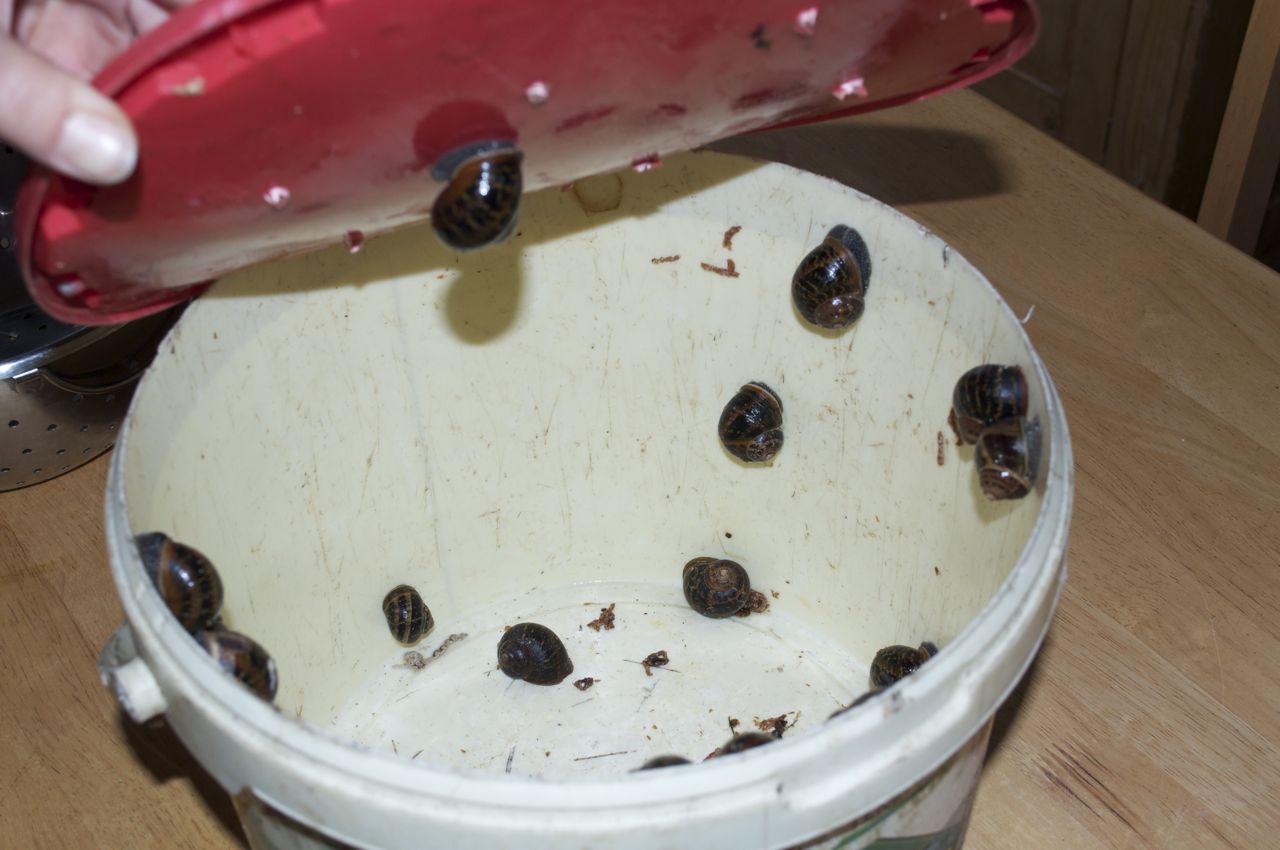
Carefully they were gathered, the gardeners’ instinct to crush the enemy was subdued and with tenderness they were carried to their temporary residence of white and red; a recycled bucket which once held mayonnaise. Into its red lid numerous ventilation holes were made with a knife. Cleaned thoroughly two lids from jam jars provided the buffet for the new occupants. One carried cool clear water, the other, bran flakes. We had tried feeding snails on other cereals, oats, whole grain spelt flour, but wheat bran is their favourite.
Snails in bucket
When preparing snails for eating, they require about seven to ten days of feeding to clear out grit from their digestive systems followed by forty eight hours of water only. The purging period is essential in order to clear their digestive systems; you never know what else they have been eating. Throughout this period the bucket was kept in our shed, cool, dry and dark. After a few days I placed a good pinch of calcium carbonate, ground limestone, for the snails to eat. This helps prevent their shells from going soft and breaking.
Every evening the snails were removed for cleaning of the accommodation. Most of the snails were either eating from the food or hanging upside down on the inside of the lid. They were removed and placed in another bucket while I wiped out their excreta and washed the box. Some of the snails were sometimes a bit messy so they also got a quick wash. Luckily they are not fast movers and although some wake up they did not seem in a hurry to rush away, perhaps they were getting used to the convenience food and water supplies of their bucket home, little did they know that their plastic home was not a holiday village, but death row. Each day though they were treated with care, fed and supplied with clean water and their quarters cleaned and their welfare checked, it was no Guantanamo, their rights were respected. After their ten-day detention period including the 48 hours fasting had finished it was time for them to be cooked.
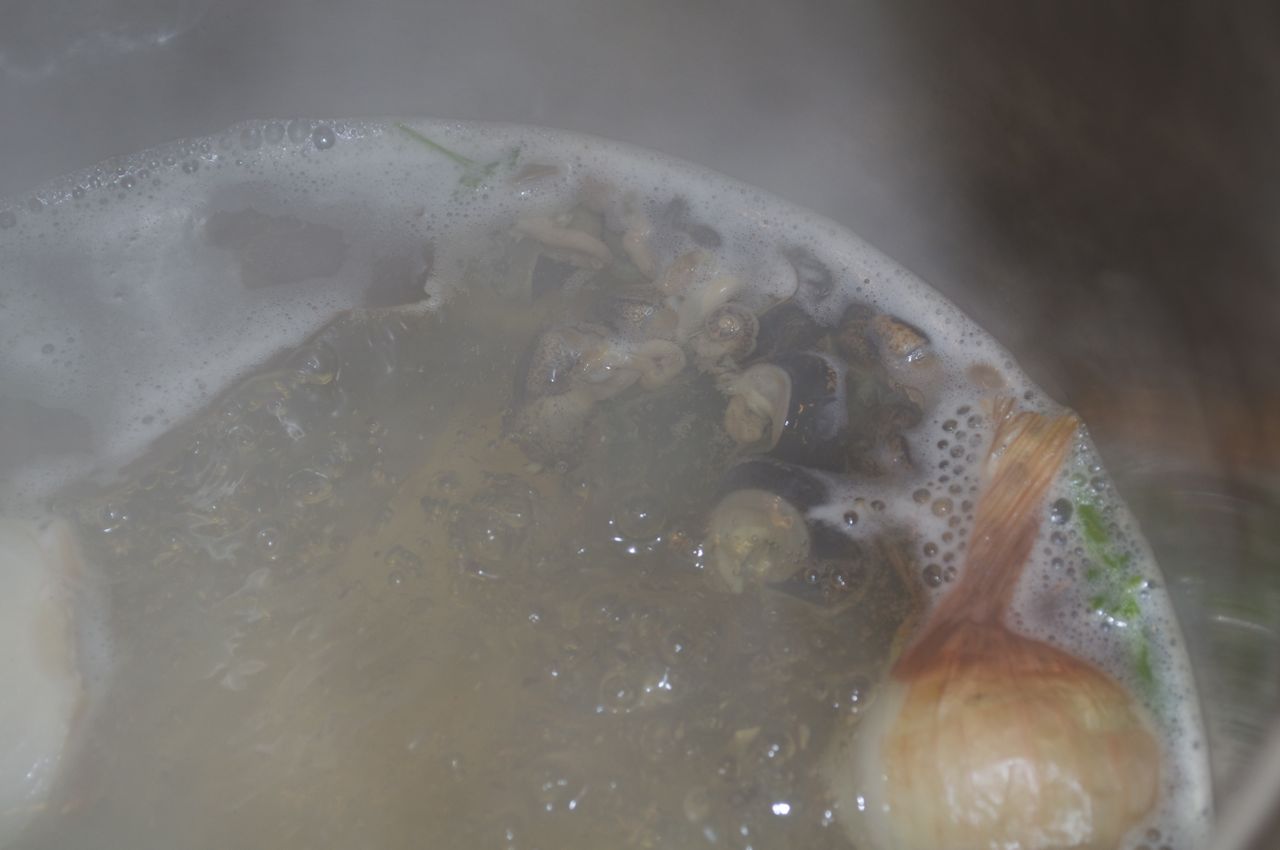
Snails in water with onion and herbs from the garden
I had help to prepare them for the table; Hanna’s brother Mika and his partner Heidi were visiting from Helsinki. Both are enthusiastic foodies and were keen to take part in our meal of vengeance.
Cooking garden snails
Remove the snails from the bucket and wash each snail under cold running water
Drop the snails into boiling water and remove after 5 minutes. Some froth is produced as mucus is released from the snails’ bodies.
The snails are removed from their shells using small forks. This is easy to do; a quick flick of the wrist imparts the swirled flesh from the shell.
The snails release a little green mucus, and may release more. To remove mucus the snail flesh is washed a number of times in diluted vinegar. Repeat until no more mucus is released.
Next cook the snails in stock or with water with herbs, there are many variations of this, we used fresh herbs from the garden including oregano, lovage and parsley and added some chopped onion to the water seasoned with salt and ground black pepper.
After 30 minutes the snails were removed and then fried in butter with garlic and parsley.
Mika and Ciaran with the snails
Snail meat
We served the snails on a bed of pinhead oatmeal sautéed with friend onion. The snails were judges to be a great success, both Mika and Heidi enjoyed them, and I did too. While in Ireland they had both dined in some really fine restaurants but Heidi reckoned that the culinary highlight of their trip to Ireland was the preparation and eating of the snails. They were very tasty, in fact, never has revenge for garden damage tasted so good.
Despite the less than summery weather over the last while I do feel that summer has indeed arrived. The reason, the ederflowers are in blossom. Sambucus nigra, common elder, is a native shrub/small tree to Ireland and all throughout the countryside its creamy white flat heads are to be seen. Apart from its medicinal uses of which there are many, the flowers and fruits are a great source of food and tastiness.
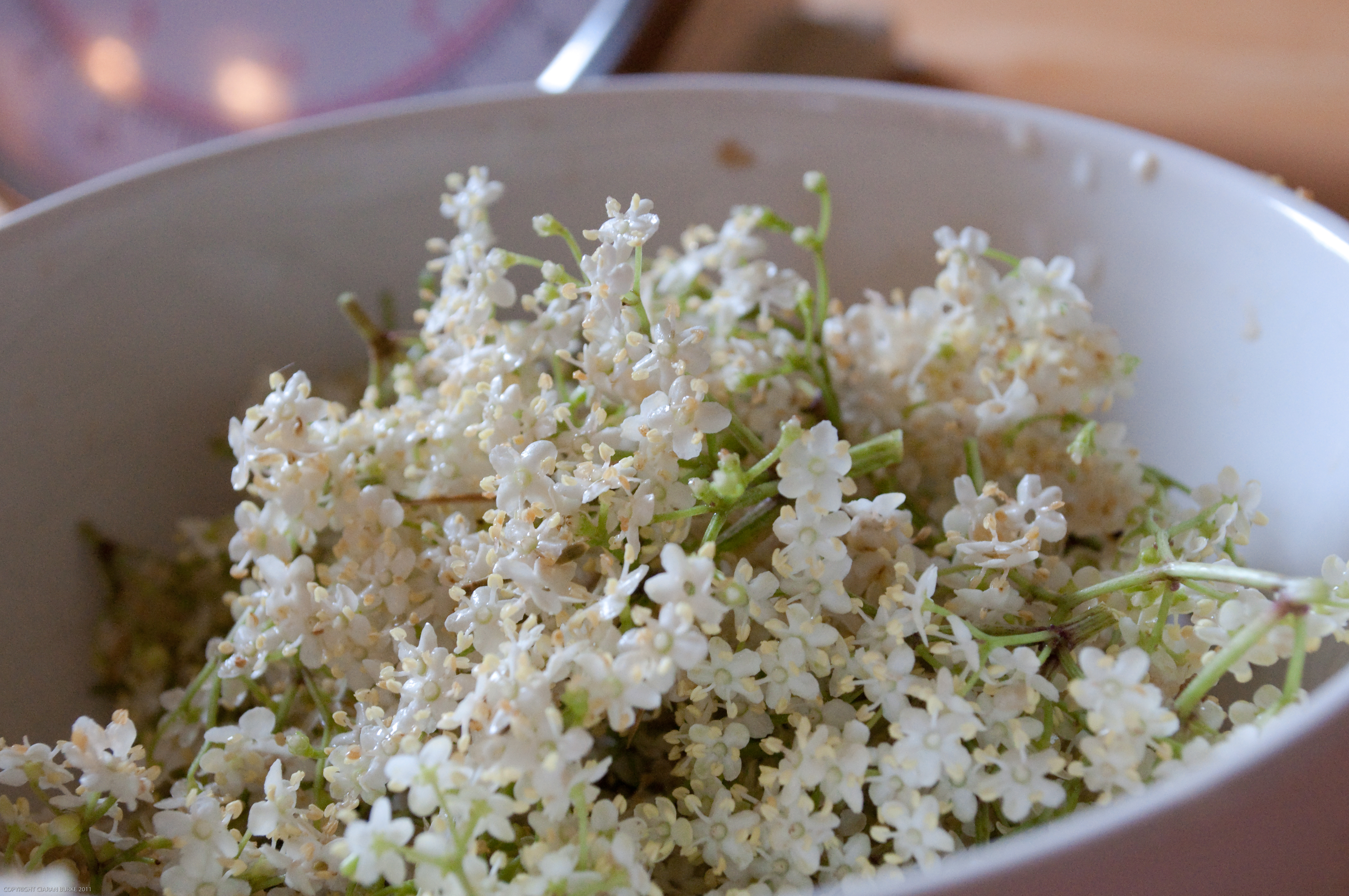
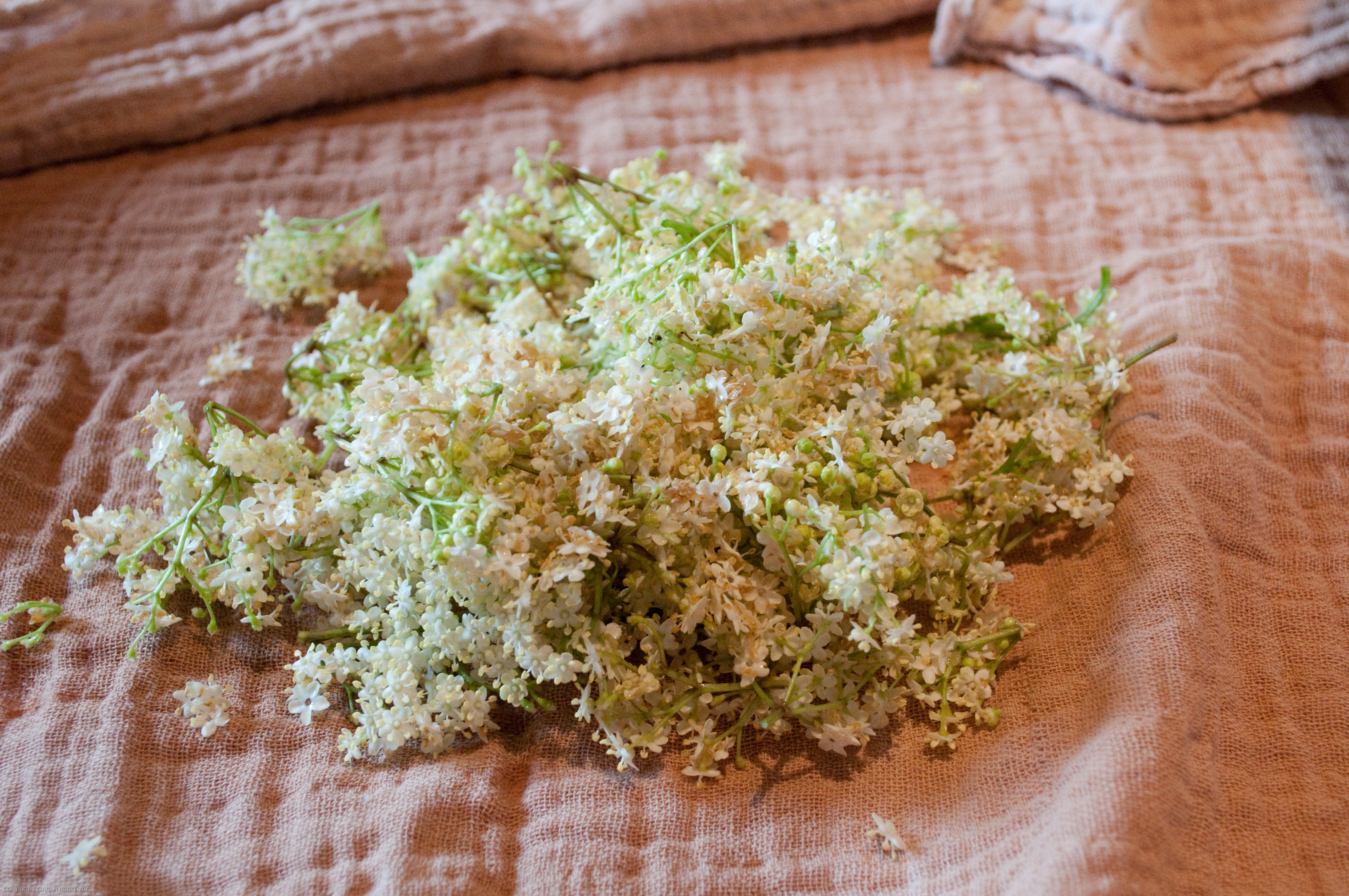
ELDERFLOWERS WASHED AND IN A BOWL
Elder is a relatively un-used plant in modern day Ireland, which is a shame. In recent years there has been a growing fondnes for elderflower cordial, which is delicious and very easy to make. On Friday evening I made a litre of cordial which will be ready to use in a few days time. -To see previous blog on how to make elderflower cordial click on the link near the bottom of the page.
I love the clear fresh taste of elder flower and have been of the opinion that there must be more ways to capture its taste apart from making cordial. On Saturday we had elderflower pancakes which were delicious. I will post a blog on how to make them soon. But to enjoy the flavour of elderflowers every morning would be a treat, a great way to exercise the taste buds at the start of each day. So my mind turned to jam, not literally, but thinking of how I could capture the uniqueness of the elderflower flavour in a fruit spread, free of sugar. This resulted is two jams, Strawberry & Elderflower and Elderflower & Apple.
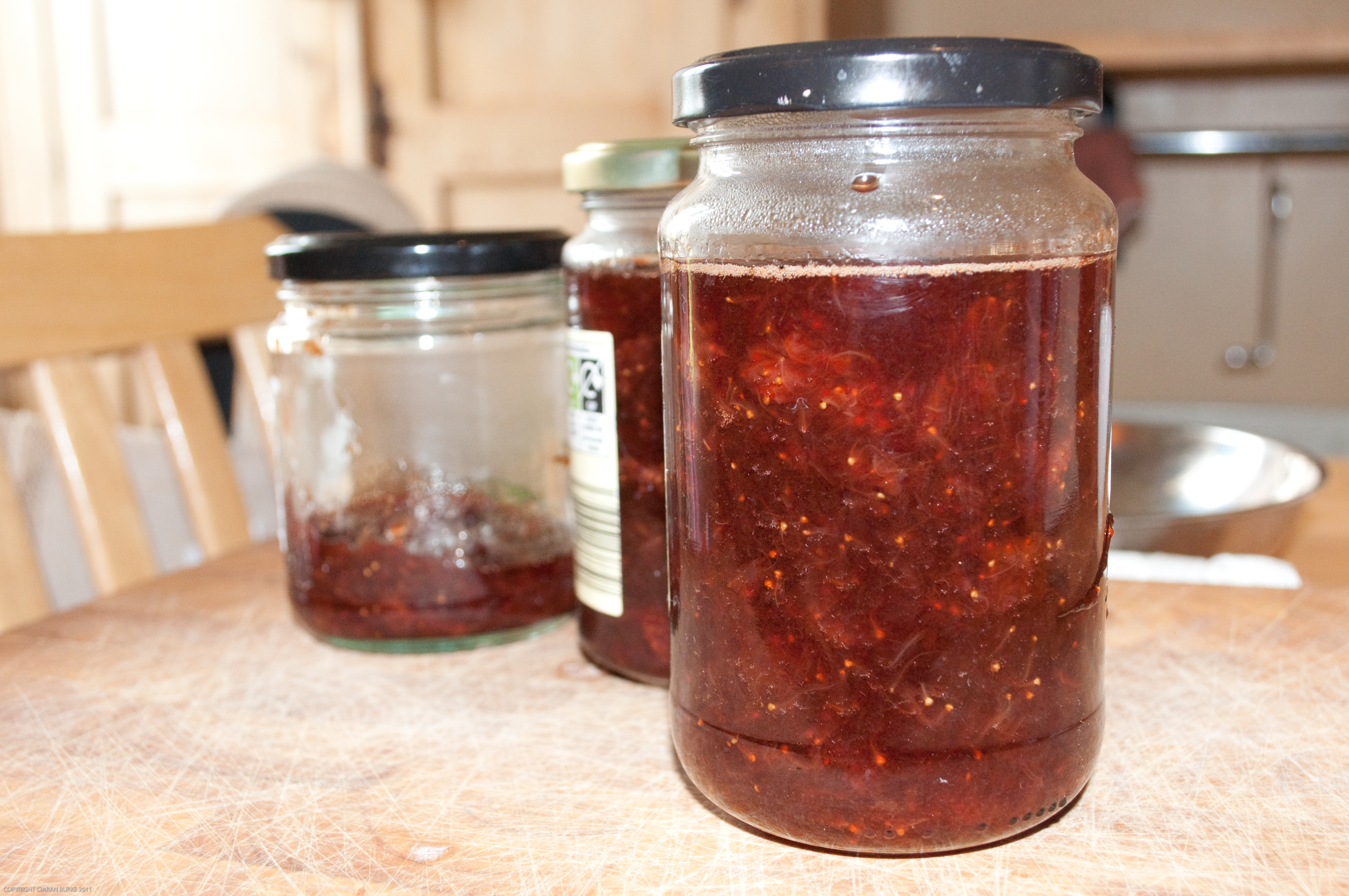
POTS OF STRAWBERRY AND ELDERFLOWER JAM
The first of the two jams I made was Strawberry and Elderflower which is very tasty, a great success. The sweetness of the strawberry seduces your tounge with sweetness then the elder flower tingles it. I made a small batch with strawberries purchased from the farmer’s market in Boyle, Co. Roscommon. But, I wanted more elderflower, and decided to try making a jam with apple. The result is fabulous, perhaps my favourite jam ever! So here are the two recipes. I like to make sugar free jams. Instead of adding sugar I use apple juice concentrate. Although it works out more expensive I do like to eat lots of jam, so it is healthier.
When making jams have clean jars ready. We use old jam jars, washed in hot soapy water then dried thoroughly. Place in a cool oven and heat to 100 degrees Celcius, about twenty minutes at his temperature should sufficiently sterize the jars.
STRAWBERRY AND ELDERFLOWER JAM (SUGAR FREE)
INGREDIENTS:
800g of strawnerries with green parts removed, large fruits were cut into halves.
8 heads of elderflowers.
360 ml of apple fruit juice concentrate
2 apples, peeled and chopped
Juice of one lemon.
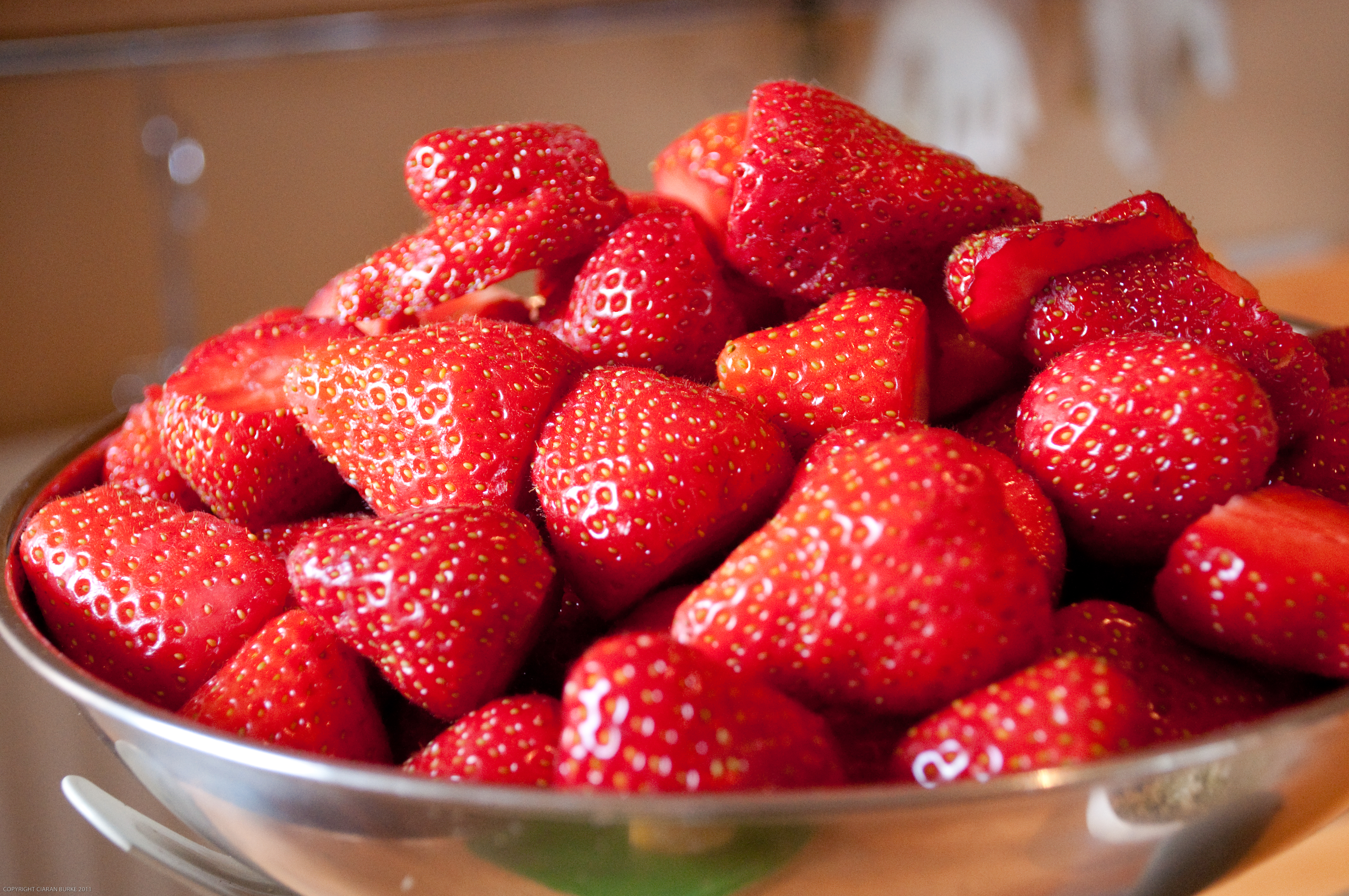
STRAWBERRIES TOPPED AND ON KITCHEN SCALES
METHOD:
Tie the flowerheads from the elder into some muslin.
Cook chopped apple in the apple juice concentrate with the lemon juice and the elderflowers in the muslin bag until the apple pieces are soft. (about 10-15 minutes) Keep the heat low after it has started to bubble.
Add the strawberries and continue cooking at a low heat until the fruit is soft. (about 20 minutes). Stir to make sure fruit does not stick or jam burn
Mash up some of the strawberries to make a pulp, leave soft entire fruit.
Turn up the heat so that the jam really bubbles. Stir occassionally.
When jam has reduced and when you move a wooden spoon across the base of the pot and you hear a good sizzle, then the jam is ready.
Spoon the jam into the jars, be careful, the jam is very hot, wear oven gloves. Clean the outside of the jars to remove any jam that you have spilled, use a clean damp cloth.
Place lids on immediatley.
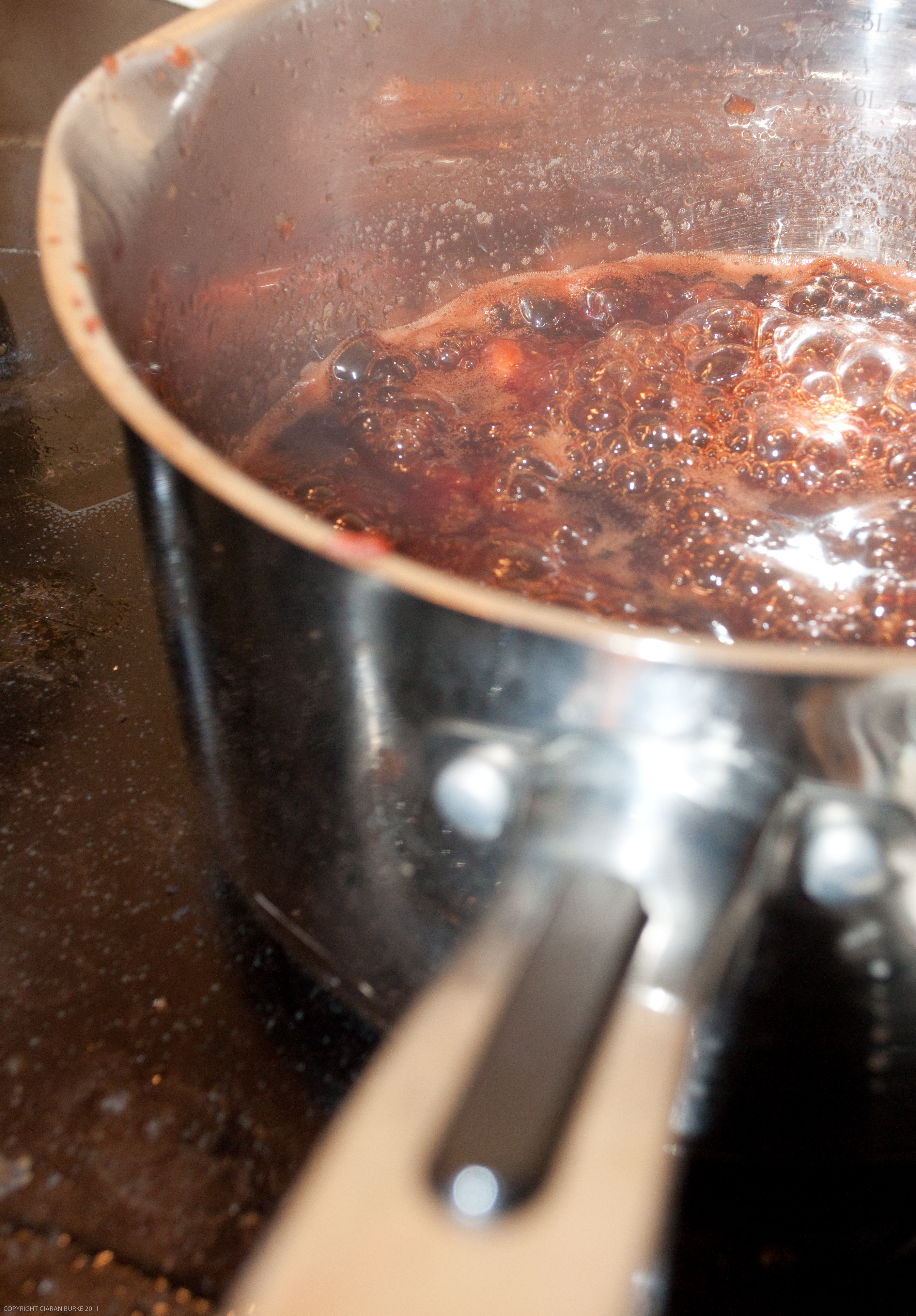
WASHED ELDERFLOWERS ON MUSLIN CLOTHSTRAWBERRY JAM COOKING IN SAUCEPAN
We have just used the last of the jam we made last october and they have kept well using this method.
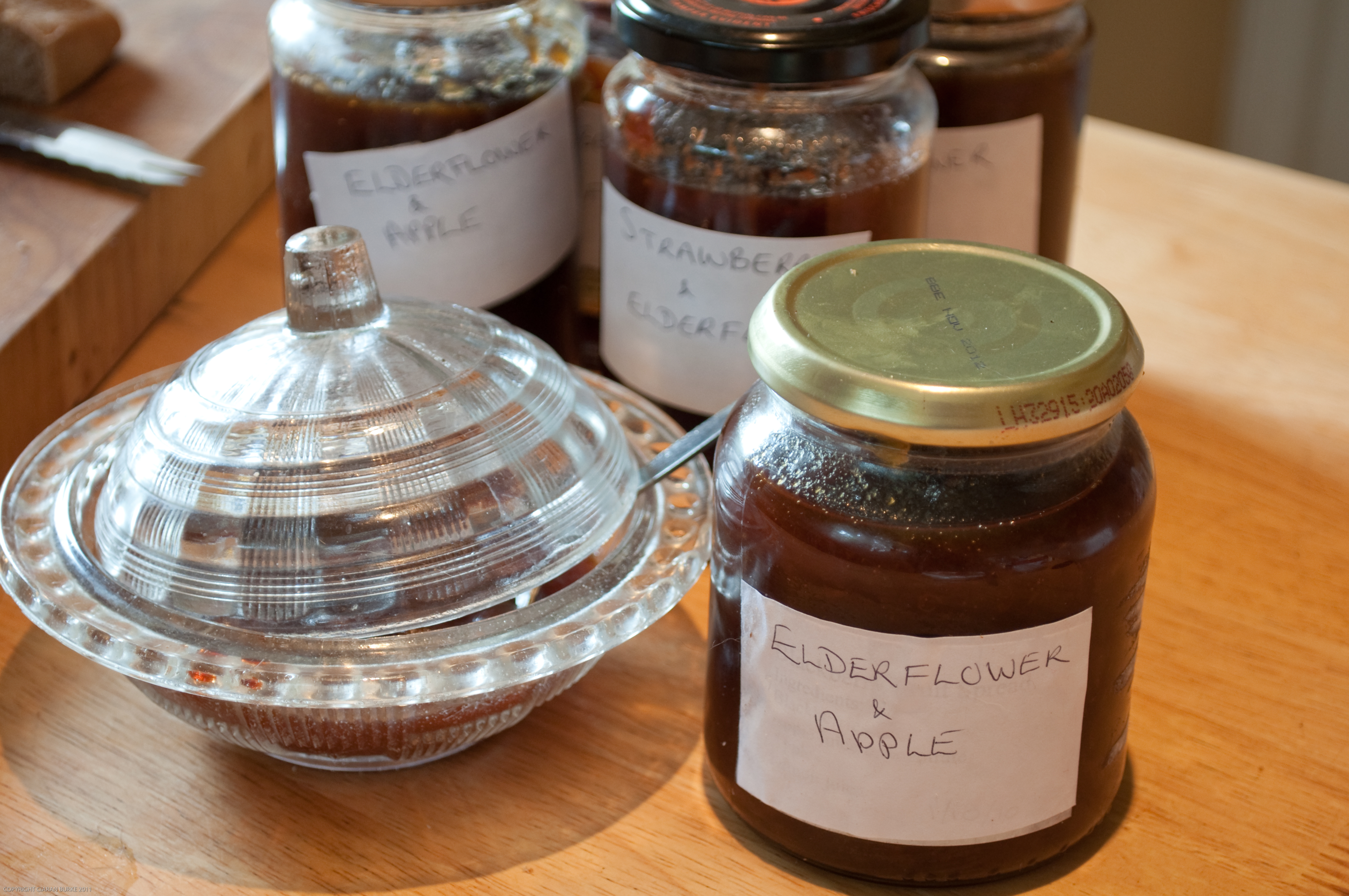
ELDERFLOWER AND APPLE JAM (SUGAR FREE)– Possibly the tastiest jam in the world!!!
ELDERFLOWER AND APLE JAM ON BREAD WITH JARS AND GLASS BOWL
INGREDIENTS:
1 1.1Kg peeled and cored dessert apples (the weight after peeling and coring). Chop into small pieces.
2 11 heads of elderflowers
3 2 x 360ml bottle of apple juice concentrate
4 juice of one lemon
MUSLIN CLOTH WITH ELDERFLOWERS AND LEMON PIPS IN APPLE CONCENTRATE COOKING
METHOD:
1 Place the elderflowers in a muslin cloth and tie to make a bag.
2 Put all the ingredients into a saucepan. Cook on a low heat until the apples are soft (15-20 Minutes). Make sure that the muslin cloth containing the elderflower is in the liquid.
3 Remove from the heat and using a hand blender, blend the apples until they are pulp.
4 Return to the cooker and cook on a higher heat. The jam will be ready in about 10 – 15 minutes.
5 Spoon into sterlized jars and cover jars with lids straight away.
ELDER FLOWER AND APPLE JAM ON BREAD
Elderflower and apple jam is delicious on freash beread or toast. Also great with some yougurt too. Even if the summer weather does not live up to expectations, elderflower will always be a summer treat in June.


















 Ciaran The Gardener