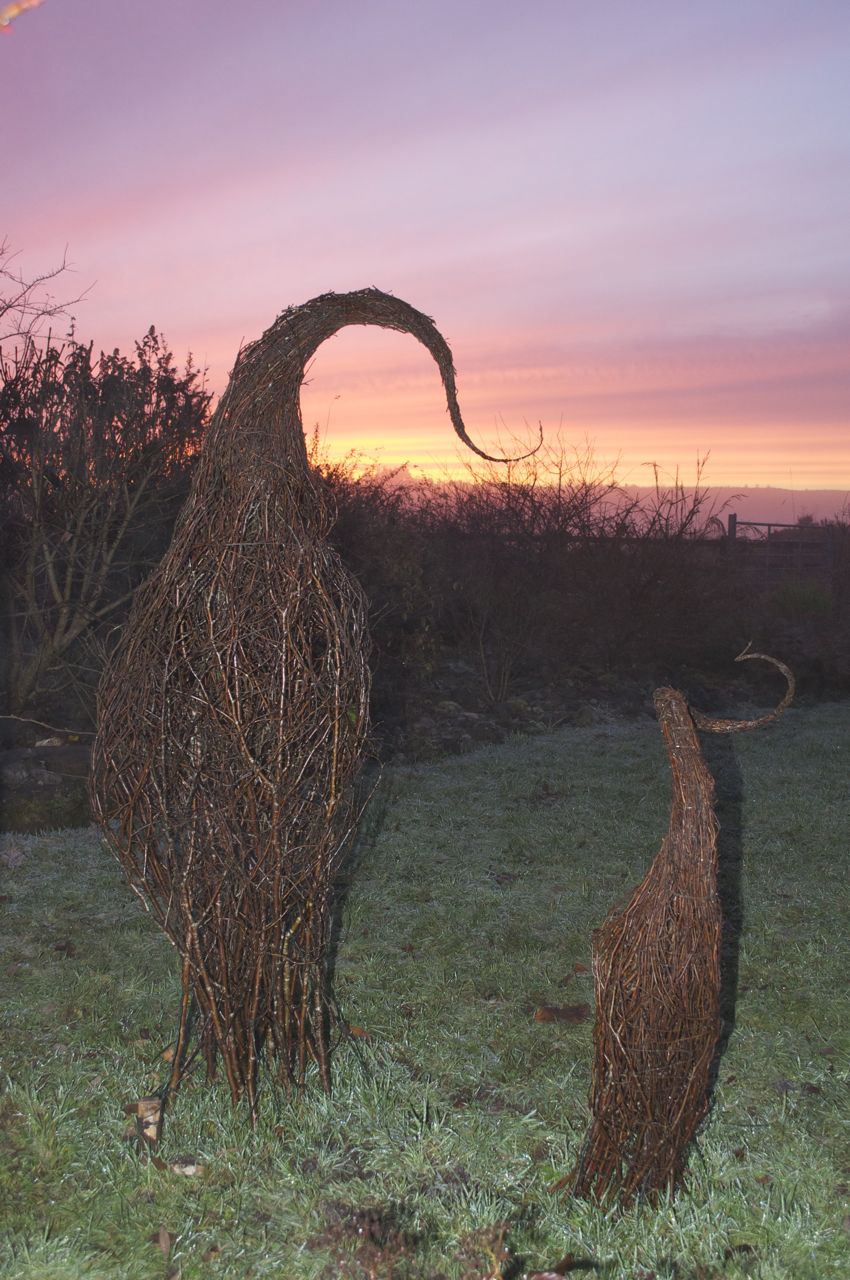
When my wife hanna and I started making Scoodoos sculpture for our garden o a little over a year ago, we had no idea what we were starting!
Now they have their own website and Facebook page and Scoodoos are visiting schools doing workshops encouraging children to love and respect nature and appreciate the importance of trees. Scoodoos are ancient tree spirits, are now they are reaching out to humans to help save the environment.
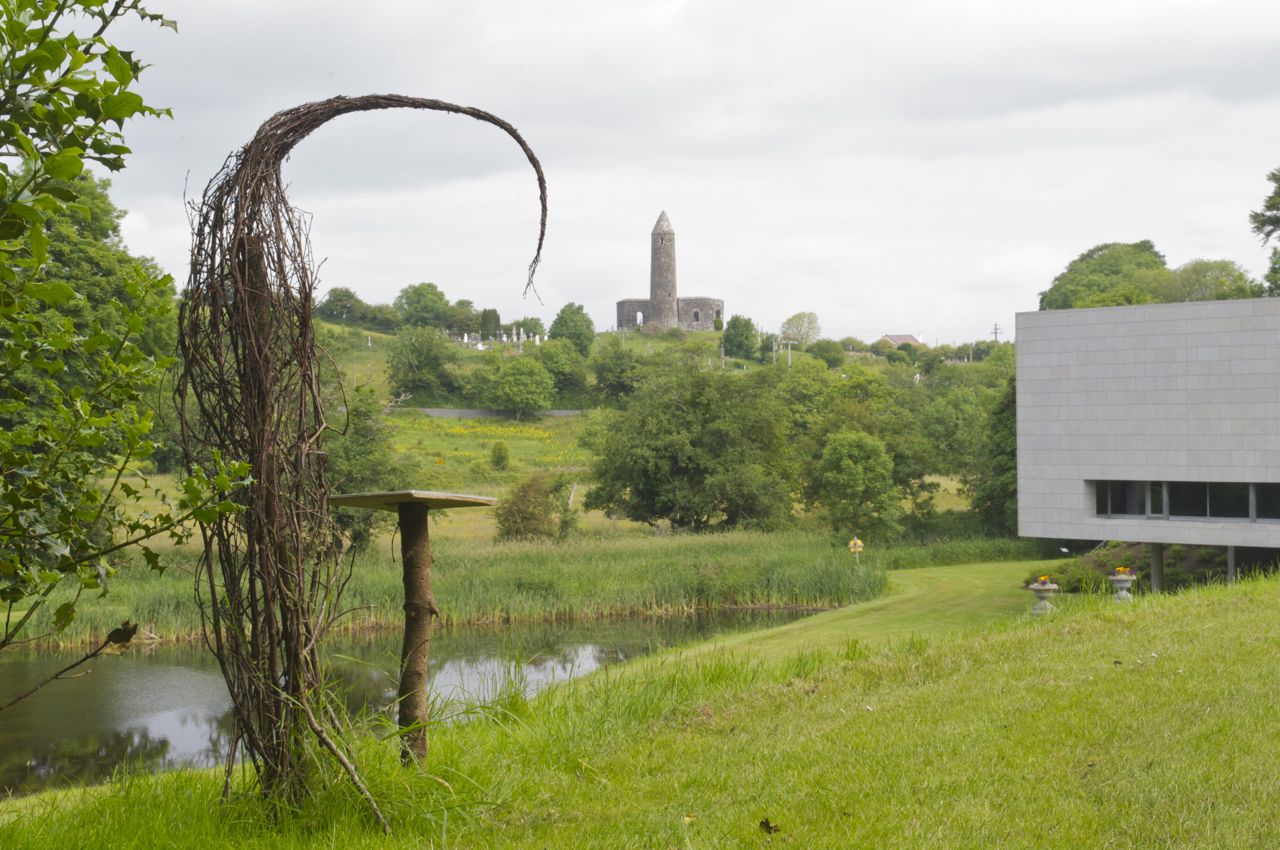
Scoodoos at National museum of Ireland -Country Life, summer 2013
A Scoodoo Sculpture trail was installed at the National Museum of Ireland -Country Life in County Mayo and also at Bloom, Ireland’s biggest gardening festival. The Scoodoos attracted attention of the Derek Mooney Radio programme on the national radio station RTE 1. Scoodoos are capturing the imagination of young and old. We are delighted, it is a fun way of bringing attention to very important issues to a new audience, both young and old. LISTEN TO THE PODCAST
The very first Scoodoos Sculptures
This Spring we are involved with galway County Council in creating a new Scoodoos Sculpture Trail at Loughrea in Co. Galway. Loughrea is a great location, where a large lake provides amenities to busy town closeby. An important amenity is the blue flag beach where bathers come to bathe in summer. http://www.beachawards.ie/
Information Evening
An Information Evening, hosted by The Garden School, relating to a Scoodos Sculpture trail in Loughrea, will take place in the Lough Rea Hotel and Spa on Wednesday, February 19th at 7.30pm. Ciarán and Hanna Burke from The Garden School, have received funding from Galway County Council under the Agenda 21 scheme to design, and install and educational sculpture trail at located alongside Loughrea’s Blue Flag beach at the Long Point on Lake Road. The Scoodoos Sculpture Trail will feature ten sculptures made from branches and twigs, with each sculpture being accompanied with an information board, displaying information about environmental awareness, and the special amenity that is Loughrea’s Blue Flag beach.
With Scoodoos, The Garden School aim to raise awareness about the importance of caring about the environment, and raising awareness of the beauty of trees and nature. The Garden School host workshops in schools, work to design and install Scoodoos Sculptures designs, and install educational trails. As part of the project, The Garden School would very much like to work with the people of Loughrea, and are inviting individuals, community, and business groups from the area to be involved.
On February 19th, The Garden School will explain the concept behind Scoodoos, show an example of a Scoodoo sculpture, and discuss how groups, and individuals can be involved in the project. If you are planning to attend the Loughrea meeting on February 19th, please email to confirm your attendance to ciaran@thegardenschool.ie More information via the Scoodoos Sculpture Trail Loughrea brouchure or at www.scoodoos.com
It is brown, barely visible, one has to look closely and bend down to examine the small flowers, thin and sinuous, like a dark rodent tail, almost hidden by the foliage. I think it is fabulous, Asarum probiscidum. The green flowers of Primula ‘Francisca’, ruffled and clustered on short stalks, pretty, not showy. Snowdrops, Galanthus sp., imagine a garden with fifty different kinds, a gardener proud of the collection. This is the world of the plant enthusiast. We plant people can be terribly nerdish, true anoraks walking around a garden on a wet February afternoon, bending to admire the subtle differences between one snowdrop and another. We “ooh: and “aah” at the green markings, only visible when viewed from beneath the white skirt of petals. Perhaps we are a bit odd.
Primula ‘Francisca’
Asarum probiscidum – the mouse plant
Living in Ireland, we have the opportunity to grow a wide range of plants. The winter air is warmed, most years, by the Gulf Stream. Our island is spared from the harshest cold by our enclosure of ocean. The rain that we all complain so much about, waters our plants. Our gardens do not really stop during the year, even in the depths of winter there are plants in growth, flowers blooming, there are fruits and foliage to admire.
Not everyone can get as excited as me about the mouse-like blooms of Asarum probiscidum, many will think snow drop fanciers are a little bit mad and very sad. That is okay. A garden is more than a collection of plants. It is not just a cabinet to display the prizes of the collector: the freaks, the beautiful, the rare and expensive.
Gardens can fulfill various functions and fancies. It can be a picture of beauty, a lively composition of colour, an outdoor room to entertain and live. It is also a sanctuary for the mind, a rest for the tired body, a rejuvenator of the spirit. Gardens can provide vegetables for the kitchen pot, fruits for the dining room table. Gardens are places to interact, with nature and each other.
Flowers moving with the wind, falling in the ‘wrong’ direction creates a moment of fun
The Dillon Garden, Sandford Road, Dublin
Plants chosen and placed to create atmosphere
A place to sit and feel the garden
Experience is essential, it makes us what we are, gives us life. The space around our homes is not just a picture, framed by the windowpane, viewed from a patio door, glanced at while putting out the bin.
Raindrops held like jewels hanging from a flower, the smell of fresh cut grass, the aroma of a crushed lavender sprig. The quiet calm of an autumn morning, the golden glow of a summer’s evening doused in sweet scents, the murky winter morning shrouded in fog, coated in frost; moments of magic, unique and sometimes fleeting. The view, the smell, the feel, they create atmosphere; we live the experience and cherish the memory.
Strolling through a beautiful garden we admire many things; the flowers, the colours, perhaps the perfume on the air. A path might lead us to a destination, but it also might guide our sight. We might be blissfully unaware that our gaze moved slowly along the airy flower heads of lady’s mantle that complemented the other yellow blooms. A golden foliaged conifer; its placement provided the structural form and resting place for the eye as the path curved way from view, invited us to explore.
Sitting on a stone bench, the air is quiet except for the rustle of leaves and the hum from insects. Comfortable and secure, restful and serene we take for granted the beauty of the scene, the experience of escape. The placement of the seat in this garden room is no accident. The height of the enclosure, the light that enters, the amount of space and uncluttered feel are elements that make this place so perfect.
If the hedges were any higher, our seat would be darker. If the opening to the path was narrower we might feel imprisoned. The hedge is high enough to make us feel private, low enough to allow us to see the sky, a protective boundary to keep the world out but not to incarcerate. Here in the haven, the degree of our enclosure, how the hedge surrounds the space and leaves a gap for entrance and exit, is a comforting hug not a tight grasp.
Beneath our feet is gravel, light, grey and rounded, a similar colour to the stone bench on which we sit. Harmony of the materials and their colour rests our senses, provides comfort. The colours around us are predominantly green, the soothing shade that relaxes our eyes. But if is not dull, not boring. Some soft pastel shades, a billowing catmint, a tall purple verbena and arching Dierama waves its angel fishing rod flowers above the stones in the slight breeze. The green leaves are not all identical; there are soft ferns in the shade and wide hosta leaves and shapely lady’s mantels topped with frothy soft yellow flowers. A quiet combination of foliage that arouses an interest but does not impose, and colour blends that recede to a respectful distance; soothing and pacifying.
Garden path
Leaving the serenity of the secluded seat we walk to the open borders. We are invigorated by the frenzy of colour that fills each facing bed separated by the fine lawn. Burning bright Crocosmia masoniorum blazes with bright orange Helenium autumnale and golden Rudbeckia. The sight is lively and inspiring.
Rudbeckia fulgida var. sullivantii ‘Goldsturm’
Crocosmia masonorum
We take for granted the depth of the borders, how each one mirrors the other in size and shape. They are deep enough to accommodate the tall plants, separated by a lawn of good proportion so that we can admire their show along their entire lengths; excellent proportion. The balance either side is subtle, almost imperceptible, yet if it is not right we notice.
The path between the borders leads us to a water feature, this garden room enclosed by the plain backdrop of soft textured yew hedges. The borders appear longer than they actually are. The designer has played with the perspective, the line are not quite parallel. The colours are chosen and graded, hot colours as we enter gradually cool; the reds and oranges mellow to yellow, mauves cool to soft shades of pastel pink and wispy hues of palest blue. The colour gradient emphasizes the fact that the hot reds jump into out vision while soft pastels move away, drifting to the distance. The result, the border seems longer that it is.
The Dillon Garden, Sandford Road, Dublin
View through an arch offers a tantalizing glimpse of what lays beyond…
Design and plants creat beautiful spaces
The water feature at the end is carefully constructed. It is a focal point on which our eyes will rest, for a moment. Not too big to be an exclamation. Not too flamboyant so as to out do the borders but punctuation in the long space.
From the centre of the round pool, water bubbles from the centre of a rock, tumbles peacefully over the sides and returns to the pool creating a lively ripple. This carefully placed pond and well designed fountain retains the atmosphere of the lively but controlled herbaceous border, the central stone is similar in tone to the surrounding paving, harmony of style and colour.
Plants can be used as ornament to decorate a space or to create the design. They can add texture, colour, form, fragrance and interest throughout the year. How they are combined, where they are placed and how they are used with other features with in our garden; if done so with thought and careful consideration, this will create a more beautiful garden. There is a little bit of a garden designer in every gardener; we must not ignore this creative part of our persona. Instead if we develop our hidden designer, express our creativity, enhance our awareness of colours, forms, balance and harmony, we can transform a collection of plants into a part of something even more beautiful.That strange dark mouse plant, that collection of bright snowdrops and the green ruffled primrose can be details in a composition of garden beauty, components of a greater garden heaven.
Entering a garden
Plant forms create visual energy
Plants chosen and placed to create atmosphere
Carefully placed objects can enhance the garden experience
Moss garden
Stipa gigantea
Euonymus americanus
Rosa ‘Fru Dagmar Hastrup’ – rugosa hybrid and fragrant
Early this morning as the fog was lifting.
Verbascum flavum, V. ‘Elin’ and Persicaria polymorpha in our garden 6-July-2012
On December 4th 2012, I decided to start a project, a photography project, but also an exercise in tree appreciation and observance of nature. Taking time each day to spend a few minutes observing a tree and its surroundings. As the photographing phase nears its conclusion, the project is taking new directions.
There is an exhibition being planned for the Spring at Charlestown Arts Centre in Co. Mayo and currently I am working on a book of the project oneTree365 -The Book.
The book will feature all of the 365 photographs of the tree,one for each day. Printing costs associated with the project will be expensive so I am trying the crowd funding route to make this a reality. My project has gone live on the Irish based site. Visit the link below to find out more about the book project and/or to support it and get a copy of the book.
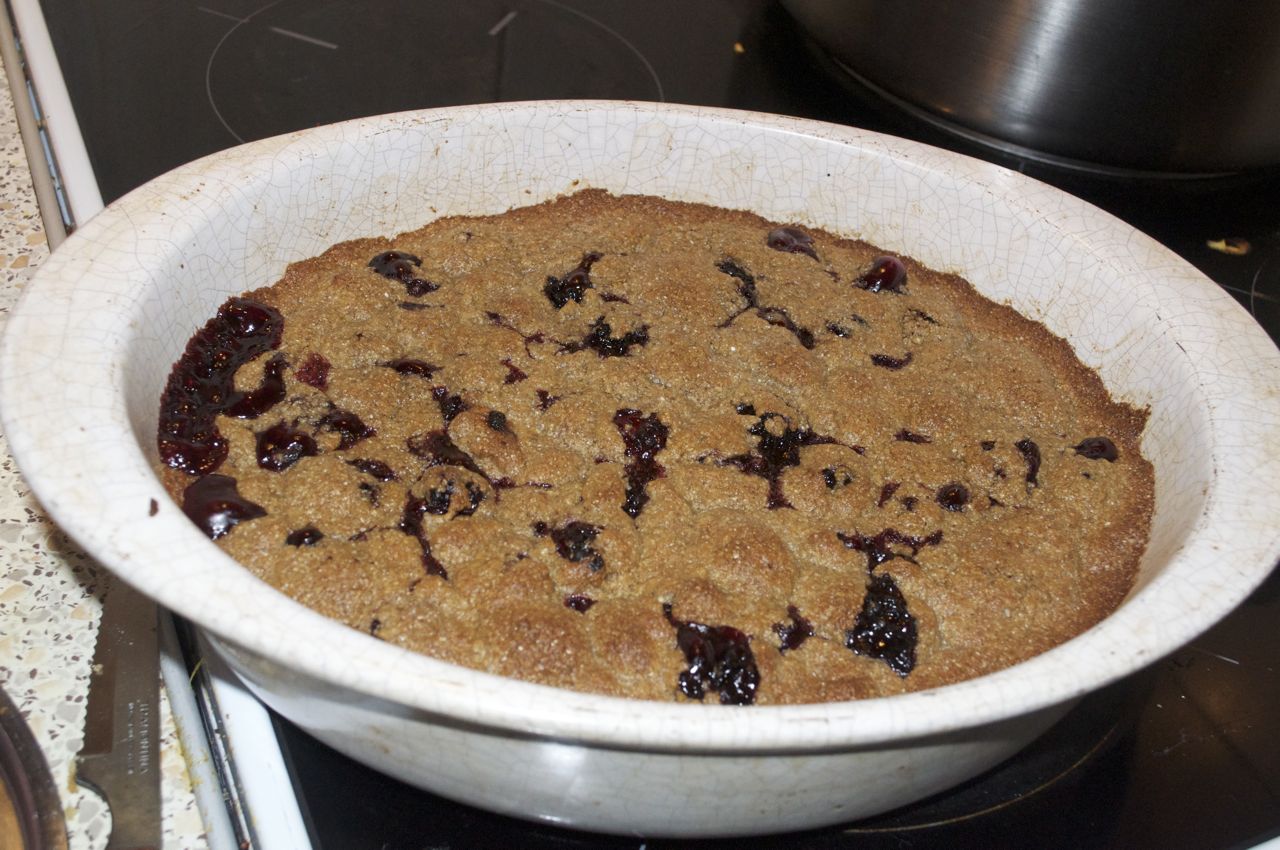
When I was first offered a fish cock in Kuopio, the capital of the eastern Finnish province of Savo, I did not know how to respond. One does not wish to be rude and impolite to the natives, but the prospect did not sound too promising. The look on my face must have betrayed my fear, it was explained to me that the fish cock was indeed a fish pie. Mustikkakukko, blueberry cock, is a blue berry pie made with a delicious rye pastry. Such pies are also called rättänä in Savo, Finland. The Finnish blueberry is Vaccinium myrtillus, what we call bilberry or froachan. The bilberry season has passed us, it is now prime blackberry season. Along the hedgerows and roads the black fruits of Rubus fruticosus, hang inviting us to pick them, and so the blackberry cock was created!
Blackberry Cock (pie made with rye pastry)
INGREDIENTS
For the pastry
250ml Rye flour
125g butter
125g light muscavado sugar, sieved
1/2 teaspoon baking powder
For the filling
700ml blackberries (about 0.5kg)
50ml sugar
1/2 tablespoon corn flour
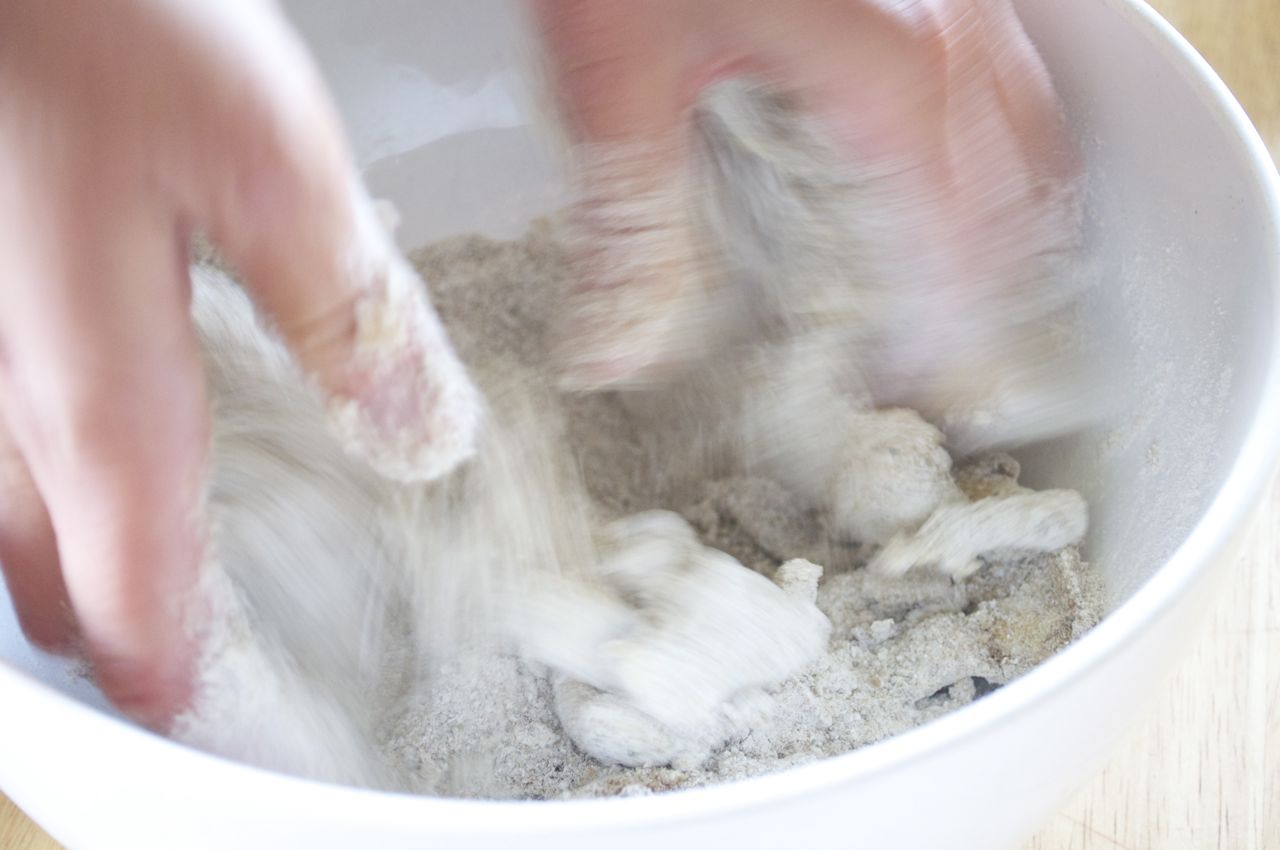
Crumbling the butter with the rye flour
METHOD
Mix together the rye flour with sieved sugar and baking powder
Crumble in the butter
Wrap in greaseproof paper and put in the fridge for at least an hour
Mix the blackberries, sugar and corn flour
Line a ceramic dish with a little more than half of the rye pastry, saving some for the top
Fill in the blackberry mix and then top off with the rye pastry. Working with rye pastry is more difficult than wheat or spelt pastry, it is very difficult to roll. So don’t worry if it does not hold together.
Place in a pre-heated oven to 200 degrees Celcius and bake for 30 minutes.
The soft texture of the sweet rye pastry is delicious with blackberries. In Finland the blueberry cock is often served with vanilla custard, that would also be perfect for the blackberry version. Serve the pie warm or cold.
When I mention foraging to people, one of the first remarks made is often in relation to nettle soup… It seems that it is probably the best known foraged food, and while nettle soup can be tasty and delicious, it is a pity to limit the experience of harvesting wild food to the same old recipes. Nettles are delicious and tasty, and can be cooked in a number od ways as a vegetable, steamed and eaten with melted butter and freshly ground black pepper, saured in rape seed oil and eaten with new potatoes or even raw in a salad! If you rub nellte leaves roughly between the palms of your hands you remove the stinging hairs. It must be done firmly and with confidence, as the old saying about grasping the nettles says…
Nettle pesto is also delicious, used as a topping for potatoes or crostini, and of course, mixed with pasta and some finely grated cheese, I like a hard goats cheese with my nettle pesto. One of the most delicious ways that I have cookeed nettles this yerar though, is replacing spinach in the classic Indiam Saag Panir recipe.
While nettles are usually used as young shoots in the spring, older nettle clumps can be chopped back now and the new growths can be harvested in afe weeks time.
Creamy Buttered Nettle Panir – Recipe
Panir is a soft cheese that is easy to make at home. Bring one litre of milk to the boil then add about 3 tablespoons of lemon juice, to make the milk curdle. Then pour the curdled milk through a muslin cloth. Squeeze the cheese in the cloth to emove remaining fluid and then shape into a flat block, like whenyou buy feta. Place the cheese in the cloth on a plate and cover with a chopping board weighed down with a tin of beans or a bag of sugar. Leave for two hours and then either refrigarate or use.
Home made panir cheese cut into cubes
Ingredients:
About 30 young nettle shoots
block of panir cut into cubes
125 butter
1/4 teaspoon of onion seeds (nigella seeds)- nothing to do with onions nor Nigella damsecena
4 curry leaves
clove of garlic
1/4 teaspoon of ginger powder
1/2 teaspoon of salt
150ml of cream
1 tablespoon of lemon juice
1 red chilli choped (optional)
Mixing the panir and wilted nettles
Method
Put nettle leaves in a steamer and cok until wilted. then cool and set aside
Melt 25g of butter in a large saucepan and slowly fry the panir cubes until browned, then remove and place on some kitchen paper
Melt the rest of the butter, add the remaining ingredients except the lemon juive and chillies. Stir for a few minutes.
Mix the spinach and panir cubes and then add to the mix.
Add the lemon juice and sprinkle the chillies on top.
Serve with brown basmati rice or home made Naan bread- delicious!
Oh how time has flown… it has been quite a while since I last posted a blog on this site. Its not that I have lost interest in gardening, foraging and cooking, I still vey much have a passion for blooms and food.
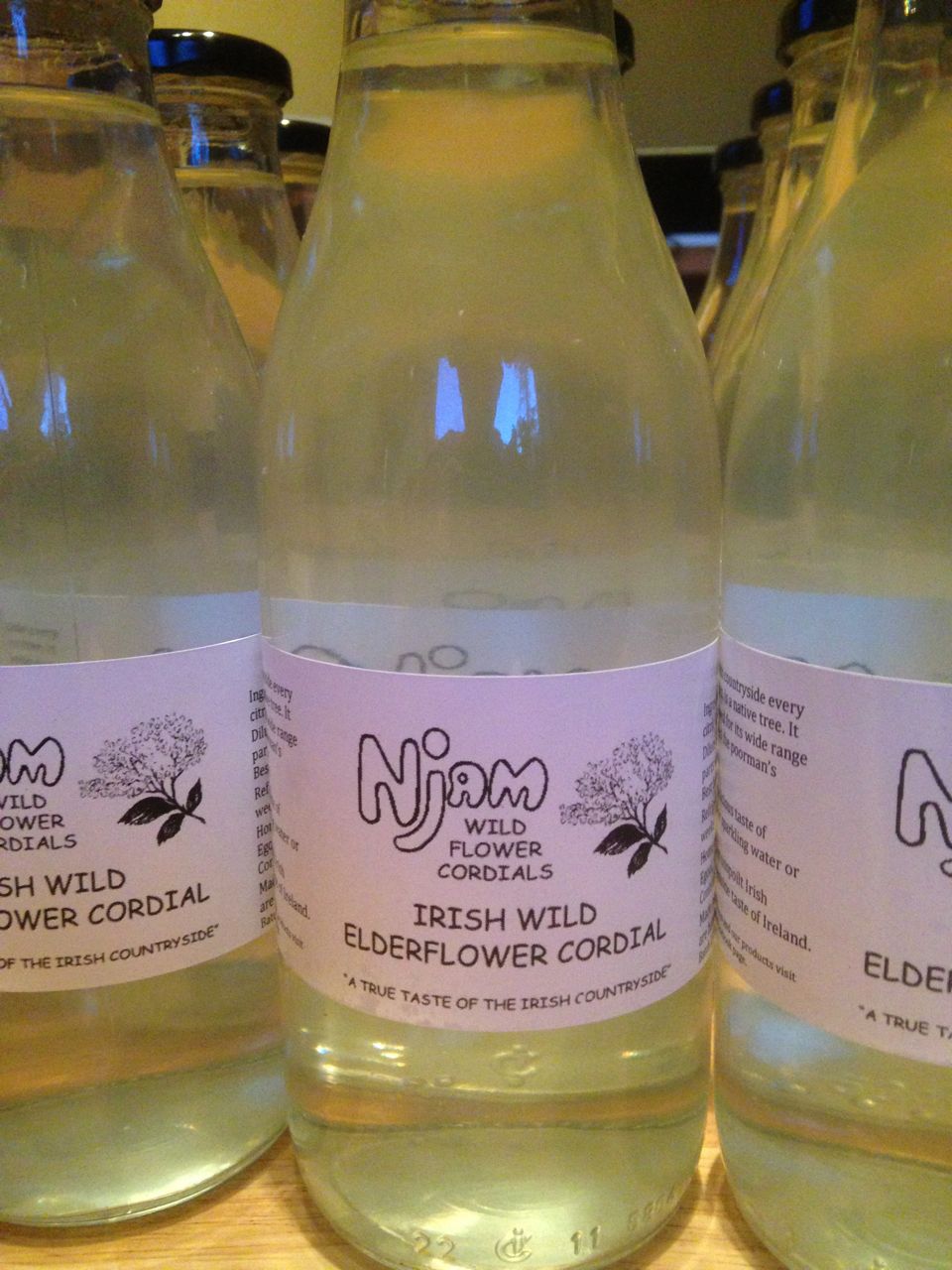
Over the last months I have been taking my foraging activities to a new degree and have started a new food business called NjAM Foods. utilizing nature’s bounty I have been busy developing a range of wild flower cordials, ketchups and jams.
This is an exciting venture. I travel around the quiet roads in our locality and harvest flowers from flowering currant, gorse, dandelion and lately elder. I love the idea of using the wild plants to produce a food product which is uniue and delicious and really captures a true taste of the Irish countryside. Apart from the harvesting, there is the cooking, bottling, labelling, marketing and deliveries, it takes quite a bit of work to convert a flower in the hedgerow to a product on the shelf of a shop, but it is a fun new challenge.
So far a number of outlets are stocking NjAM Foods products:
Cafe Rua, Castlebar, Co. Mayo
Dew C Fruit & Veg, Ballaghaderreen, Co. Roscommon
Kate’s Place, Oranmore Town Centre, Orenmore, Co. Galway
Brid Tiernan at the Carrick on Shannon, Longford and Boyle Farmers Markets
and
Brogans’s Health Food Store in Bioyle.
The products we have made include Beetroot ketchup, Carrot Ketchup and Beer Ketchup. The wild flower cordials include Elderflower, Gorse, Flowering Currant, Danelion and soon it will be time to pick meadowsweet blossoms.
I have also been making jams; gorse flower, elderflower and meadowsweet from the wild flowers. Pina Colada, Rose and Apple are a bit more unusal but we are also making rhubarb and Vvanilla and delicious strawberry jam.
For some of our clients we supply the products labelled specifically for our suppliers as we do for Kate’s Place and our gorse flower jam for Cafe Rua.
We have a website, a Facebook Page and Twitter account too…
I have also been busy with our Scoodoos www.scoodoos.com, ancient tree spirits helping to save the planet, and my one tree photogrpahy project www.onetree365.com
I have also had time to forage for dinner and have been using foraged wild plants to give a wild twist to a couple of indian recipes… next blog will feature Saag Nettle Panir… and it wont be 4 months, promise…
Today is March 8th, International Women’s Day. Women gardeners are amongst the best known in the world, yet on TV programmes, the main garden presenters are usually men. Today I remember An inspirational lady, a real titled lady, Valerie Finnis ho was also known as Lady Scott. I am reminded of her as I see the buds of a flower bulb come rising from the soil each Spring.
Muscari armeniacum ‘Valerie Finnis’
Every Spring is a reunion for gardeners. We get the chance to re-acquaint with old friends and are surprised by the appearances of forgotten ones.
The tops of their blue heads push through the cold earth. Their neighbours are mostly asleep; dormant woodland flowers that lie below blankets of soil and autumn leaf fall. I rediscovered them as I worked on my hands and knees on a calm and misty January morning, as my trowel uprooted less restful weeds unwilling to take a winter break. Muscari ‘Valerie Finnis’, their flower buds hunched together like rugby players in a scrum, collectively determined to welcome the lengthening days. Too eager to wait for spring on the calendar, their pale blue flowers will opening from the bottom, the first to celebrate.
This relative of the better known, darker blue grape hyacinth, M. armeniacum, is always such a welcome sight in early spring; a well behaved dwarf bulb free of the undesirable invasive characteristics of its relative.
That it should be such a refined bulb is reflected in its name. Valerie Finnis was a great plantswoman, renowned garden photographer and unique character. Sadly no longer with us she passed way in October 2006. Part of her legacy lives on with the Merlin Trust, set up to help finance travel for young horticulturists, to see plants growing in the wild or in gardens. Each year when I see the first flowers of the fine Muscari I have fond memories of the telephone conversations with the great lady.
I was hoping to receive funding for a trip to Namaqualand in South Africa. There I was stirring a pasta sauce, when she first called. I was so shocked and surprised I can hardly remember what was said. All I do remember, “You Irish chaps are always so charming” or words of similar effect, I had a positive feeling of success. After the trip was completed she called to ask how I got on. With genuine interest and enthusiasm she asked about details and of the plants that I saw. Still years later, I received magazine clippings about the area I had visited, which she thought might interest me.









 Ciaran The Gardener